From basement to Madison Square Garden: ‘The Basement Yard’s’ rise on Spotify
December 2, 2025
The New York comedy podcast “The Basement Yard” grew from a one-man basement setup to a six-person team and nearly 2 million Spotify consumption hours — all by staying true to friendship and authentic conversations.
When Joe Santagato started recording “The Basement Yard” in his mother's basement nearly a decade ago, his goals were modest.
"I started it for selfish reasons," he says. "If I can make an extra couple hundred bucks a month, that would be great."
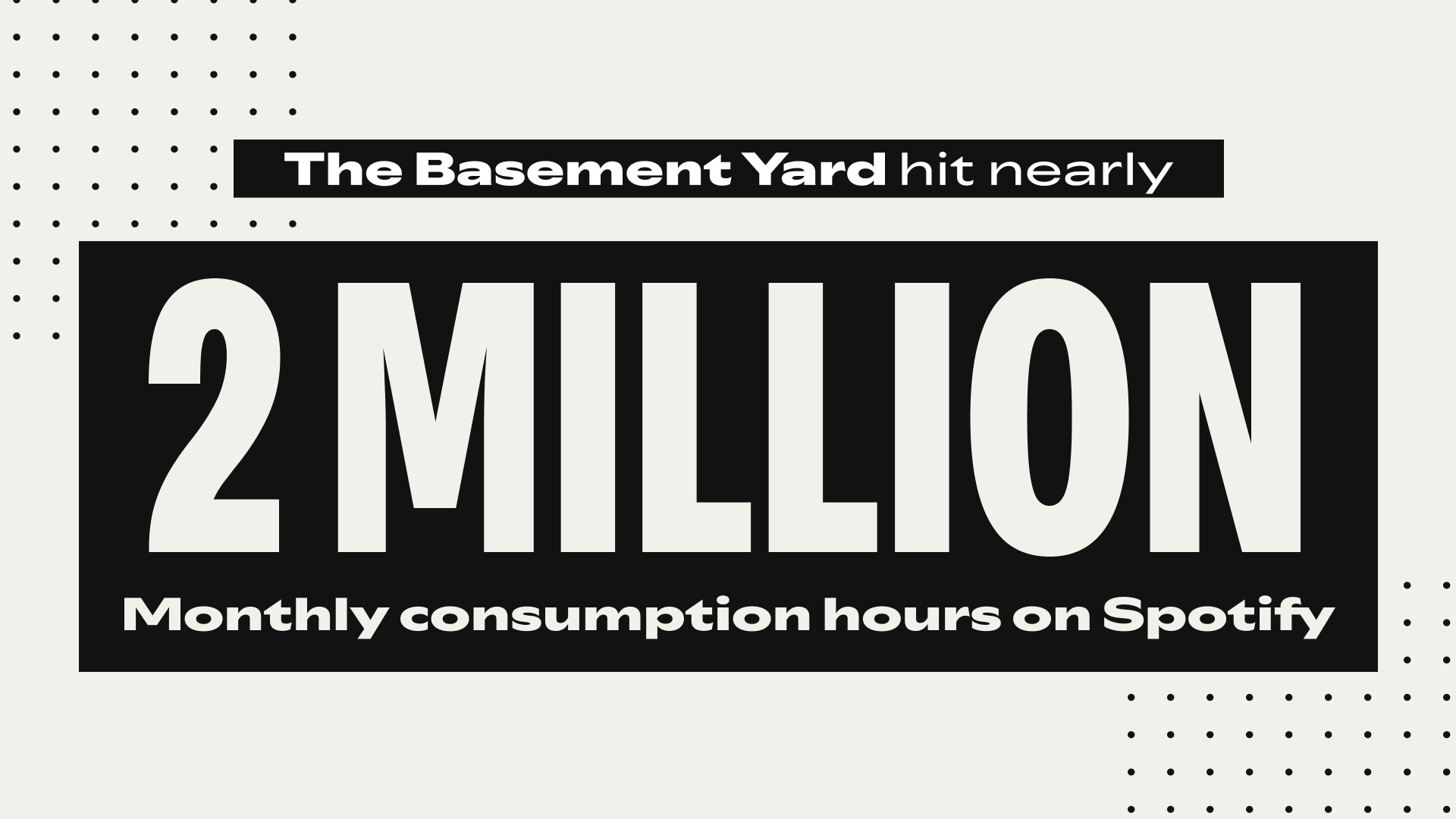
Fast-forward to 2025, and Joe and his co-host Frank Alvarez just performed at Madison Square Garden — one of the world’s most iconic venues in his hometown of New York City. Two months prior, their podcast hit nearly 2 million1 consumption hours on Spotify in a single month. "I don't even believe that. That’s quite a stat," said Joe when we first told him the numbers.
Key takeaways from “The Basement Yard’s” journey:
Joe started recording alone in his mother's basement around 2015 with modest goals of making "an extra couple hundred bucks a month."
Over the years, he and his co-host Frank have maintained an authentic, unplanned conversation format as they have grown. They actively avoid scripting content to keep it "more fun for us."
In May 2025, they added video on Spotify to meet fans where they already were, seeing a 25% increase in Spotify audience year to date.*
The show hit nearly 2 million1 monthly consumption hours on Spotify in September 2025.
They've recently scaled to a six-person team working from a professional studio space.
Joe and Frank wanted to create a more interactive experience by booking live arena shows across the country, culminating in Madison Square Garden in New York City.
*Results achieved by individual creators may not be typical of all creators.
Born in the basement
"The Basement Yard" began exactly where its name suggests. Joe, now 33, started the comedy podcast in his mother's basement around 2015. His co-host Frank Alvarez, a childhood friend from Astoria, Queens, permanently joined in 2020.
Podcasting’s unscripted nature greatly attracted him to the medium.
Originally, podcasting intrigued me because when I was posting other content on the internet that was more planned and heavily edited…I knew how the video was going to come out. But with podcasting, it's kind of off the cuff. It's a lot more interesting to me when you can find the content within a conversation with somebody.
What began as a solo creative outlet has transformed Joe into the CEO of his own company.
"In addition to being talent on “The Basement Yard,” I am also the CEO of our company, so I'm kind of overseeing everything that's happening here," he says. "For a number of years, I was doing everything like editing and the cameras and whatever, and I don't know how to do any of that, by the way. I was just kind of figuring it out on my own."
Over time, the show scaled from a solo basement operation to a six-person team, including a producer, designer, merch creator, and editor.
Why add video?
"The Basement Yard" was already experiencing steady growth and success with its audio-only format when they decided to expand their reach and innovate their format. In May, they made a move that would accelerate their growth trajectory: adding video on Spotify.
"I was inspired to add video to my content on Spotify because I think that Spotify is a great platform. I am a user of Spotify. I have been for years," Joe says.
I think that a lot of people are already listening to music and they're listening to the podcast there, so to offer video there as well — it just makes a lot of sense.
Joe assumed video would simply provide "an extra service" to their existing audience. But the results exceeded those modest expectations.
Since adding video on Spotify, "The Basement Yard" has seen a 25% increase in Spotify audiences year to date.
He also notes that adding video on Spotify didn't cannibalize their existing audience elsewhere; instead, it opened up new opportunities.
The discoverability that Spotify offers really helps. It's nice to know that a stranger can watch our podcast and go, ‘you know what, I'm going to check out these guys.’
Joe applied the same bold thinking when it came time to upgrade their recording space. He recently moved the operation into a professional studio space, making a calculated bet on their trajectory.
"I took the risk in taking on this sort of financial burden because I believe in the growth of the show," he says. “Once I saw the trajectory of the growth was extreme, I was like, let me get into a space that I won't have to move out of in a year or two."
From podcast to live experience
Success with video on Spotify represents just one part of “The Basement Yard's” broader evolution from side hustle to full-scale entertainment business.
This is most visible in their approach to live shows, which has taken them from small venues to sold-out arenas.
"The one thing that inspired the decision to go on tour was money," Joe jokes, before getting serious.
The reason why we went on tour is because we felt like the show was getting to a different level, and people were asking for it for years.
But Joe didn’t want to simply replicate their podcast format on stage.
"We didn't want to sit in chairs, look at each other, just do what they see on the internet, and then have people pay to do that," he says.
Instead, they developed what became "The Basement Yard Experience" — a live, unscripted, and unpredictable format with full audience participation.
The investment in creating something genuinely different has paid off, with arena shows in cities like Boston, Washington D.C., Orlando, and Tampa, leading up to their finale at “The World’s Most Famous Arena”: New York’s Madison Square Garden.
For creators considering live shows, Joe's advice is practical: "You've got to just get reps in, so you've got to just do it. You could plan and plan and plan, but you do the first show, it's going to suck compared to your 30th show."
I think that, eventually, if you just do the same thing over and over again, that an audience gets bored," he says. "It's important to keep your show exciting, but also give the fans the thing that they want.
Grow your audience with video on Spotify
Joe's experience shows that adding video to an already successful podcast can open up unexpected discovery opportunities. While every creator's journey is different and results like hitting 2 million consumption hours aren't typical, the potential for organic growth through Spotify's platform is real.
If you're already building an audience with audio, video might be your next strategic move.