The Utah School Mental Health Podcast
By The Utah School Mental Health Collaborative
Music by: Zachary W. Bacon, University of Utah music composition student
Mental Health Funding & Policy
We have featured a long list of stakeholders who are deeply involved in this work in Utah- all the way from trainers in mental health, mental health professionals, educators, community providers, community advocates, mental health program administrators at the school and state level, health professionals, legislators, and mental health funders and donors. So if this is the first time you are listening to us, I would highly encourage you to check out all the other episodes we have released.
With that being said, we can go ahead and jump right into today’s topic to learn more about what mental health funding and policy is, why it is so important for us Utahns, what we should know, and what we can do to support it.
Meet our guest speakers
Doug Thomas: Community Health Director at Intermountain Health focused on mental well-being and suicide prevention, as well as supporting efforts to address equity, social determinants of health, food scarcity, chronic disease prevention and treatment. Previously, Doug worked as a psych tech, human service worker, case manager, social worker, County Director and State Director in Utah's public mental health system. His work focuses on increasing mental health and substance misuse education, state and community coalitions, prevention, treatment, recovery support, peer support and social determinants of health work in the Intermountain West. He is passionate about policy work that impacts the intersectionality of risk and protective factors in physical, mental, community and determinants of health work.
Kristina Pexton: Parent of five in Davis County. She is currently serving as the Health Commissioner for Utah PTA, after serving one year as Utah PTA Family Life Commissioner. She was also an Elementary PTA President in 2020-21. She is a self-described, hard-core volunteer and advocate for our community. She volunteers with the high school mountain bike team, South Davis Communities that Care (Chair), Centerville Jr High Community Council (vice chair) and PTA. Kristina has parented her five children in Utah, Japan and Brazil. She loves to travel, learn and make a difference.
Tiana McCall: USBE’s School Social Work/School-based Mental Health Specialist. She joined USBE in July 2021 and previously worked as a School Social Worker with Elementary Students for five years. She specialized in serving Refugee Youth and Families and has a passion for Macro-level Social Work, which is what brought her to this role with USBE. She also has a private practice in which she specializes in Parent Child Interaction Therapy and loves supporting parents and their children in a therapeutic setting.
Music by: Zachary W. Bacon, University of Utah music composition student
Mental Health Prevention & Intervention
We have to adopt the no one size fits all approach and really meet schools where they are at if we want to integrate effective systems into schools. Let us emphasize that prevention and intervention services are super important in our schools- they help increase positive outcomes and decrease negative outcomes for our students. So how does this all fit within a comprehensive school mental health system puzzle? Let's explore more as we share our journey or path into this work, focusing on youth suicide prevention and intervention.
Meet our guest speakers
Andrea Hood: Utah Division of Substance Abuse and Mental Health as a Prevention Program Manager overseeing the “Project AWARE (Advancing Wellness and Resiliency in Education)” grant. This project targets three school districts to increase youth social and emotional learning skills, mental health literacy for all, and access to quality mental health services; while improving health policy and collaboration at the school district level. Andrea has her BA in Psychology and her MS in Health Promotion and Education, both from the University of Utah. Andrea has been working in public mental health promotion and suicide prevention since 2012, and at the state level she has had the opportunity to mentor several organizations as they reformed their policies to improve crisis response and suicide prevention services.
Tiana McCall: USBE’s School Social Work/School-based Mental Health Specialist. She joined USBE in July 2021 and previously worked as a School Social Worker with Elementary Students for five years. She specialized in serving Refugee Youth and Families and has a passion for Macro-level Social Work, which is what brought her to this role with USBE. She also has a private practice in which she specializes in Parent Child Interaction Therapy and loves supporting parents and their children in a therapeutic setting.
Tanya Albornoz: Earned her Masters of Social Work at the University of Utah and is currently licensed as a Clinical Social Worker. Tanya worked for 20 years in Utah’s Child Welfare system as the state Foster Care and Adoption Program Administrator prior to joining the Utah State Board of Education (USBE) in January of 2020. Tanya has a passion for all things related to prevention science and school-based behavioral health, and is a certified national trainer for Center for the Study of Social Policy’s Protective Factor Framework. Tanya was recently promoted to be the Education Coordinator for School Counseling and Prevention for At-Risk Students Programs at the Utah State Board of Education, in which she oversees all of USBE's prevention specialists and the School Counseling specialists. Tanya also practices as a part-time therapist at a treatment program for youth and is the mother of three beautiful daughters.
Music by: Zachary W. Bacon, University of Utah music composition student
School Mental Health: Handle With Data
Data paints a picture to understand current needs and trends in mental health. While we all know that the data is important, not everyone feels the same way when hearing the word 'data.' Many times, when someone hears about data for the first time- be it data collection, data analysis, data reporting, data management, data review, etc - it can feel a little overwhelming and intimidating! As trained individuals in data collection and analyses, it is so easy to use complex language. So if we want to send a message through our data, we have to communicate those in ways that are meaningful to our listeners.
Meet our guest speakers
Susannah Burt: Substance Use and Mental Illness Prevention for over 20 years. She has been involved with administering, coordinating and promoting data from the Student Health and Risk Prevention (SHARP) survey since 2003. Recently, Ms. Burt embarked on her next journey, as an Assistant Director at a local mental health facility.
Jaewhan Kim: Associate Professor in the University of Utah’s College of Health, an associate director of the Health Economics Core at Clinical & Translational Science Institute, and a data scientist at the University Medical group. He has more than 10 years of experience as a health economist and statistician, leading the health care utilization and cost analysis, statistical design and data analysis for a wide range of social and biomedical research endeavors, including cohort studies and cross-sectional studies. He is instrumental in designing and developing Utah's All Payers Claims Database.
Shauntelle Cota: Coordinator of Safe and Healthy Schools at the Utah State Board of Education (USBE). In this role she works with school based mental health specialists and school safety specialists to ensure that Local Education Authorities (LEA) have access to the processes, procedures, and resources needed to maintain safe and healthy schools. She is a seasoned educator with over 25 years of experience. She has served as a teacher, administrator, consultant, counselor, and professional development expert. She believes in the power of education and is dedicated to advocating for the needs of students and educators across the state.
Music by: Zachary W. Bacon, University of Utah music composition student
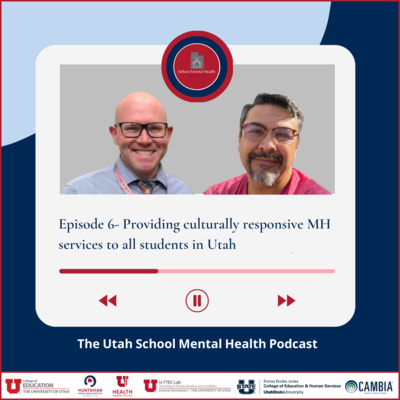
Providing Culturally Responsive Mental Health Services to All Students in Utah
In order to provide culturally responsive services, we as mental health professionals need to have an optimum level of training around some domains. We all have to understand and believe this work is important. By us, I mean we who are the direct service providers and us who are also at the system/ organizational level. As providers who have been in both worlds, what are some everyday things that we can do to ensure we are fully culturally responsive individuals?
Meet our guest speakers
Trevor Olsen: Student Services Director for the San Juan School District. He is a former JJS Counselor, Juvenile Probation Officer, School Counselor, and School Administrator. He has a Bachelor's Degree in Criminal Justice, Masters degrees in Educational Counseling and Educational Leadership and an Educational Specialist. Degree from Arkansas State University. He has been implementing school based mental health counseling, trauma informed practices, restorative practices and Navajo Peacemaking as an alternative to discipline. He continues to collaborate with the Navajo Nation and the Ute Mountain Ute Tribe to implement demonstration grant (NYCP, ACE) funding from the Federal Office of Indian Education.
Javier H. Alegre: Executive Director at Latino Behavioral Health Services in Salt Lake City, Utah. Javier has a deep passion for community-based programs. This passion was born from lived and professional experiences in Utah's Latino and peer/recovery communities. Javier is originally from Chile but has resided in the United States since 1992, when he attended the English Language Center at Brigham Young University in Provo, Utah. Javier has a Bachelor of Science in Business Administration and Finance and is a graduate from The Eccles School of Business at the University of Utah Nonprofit Academy for Excellence. Through his professional experience, Javier has developed strong management, operations, fundraising, development, and communications skills.
Music by: Zachary W. Bacon, University of Utah music composition student
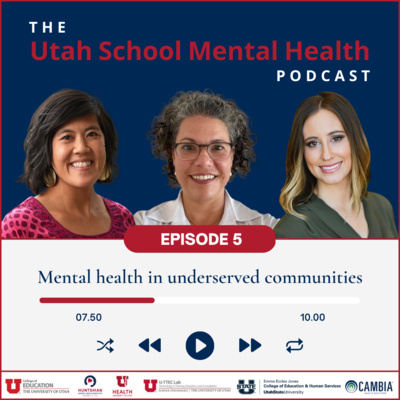
Mental Health in Underserved Communities
With high prevalence of mental health illnesses in the state and large unmet needs, there is always going to be work to do. We have to work harder to reach underserved populations and understand their challenges and strengths with respect to their stories and lived experiences. The stigmas around this topic are so large, but what we can do is keep talking and keep working. It is so important to divide and conquer- because really it takes a village to support student mental health and well-being and do this important work- and we definitely cannot do it alone.
Meet our guest speakers
Tasha Seneca Keyes, PHD, MSW: Former school social worker and her practice experience in K-12 schools has shaped her research, which focuses on finding ways to promote belonging and engagement for underrepresented students, with a particular focus on Native students. Tasha also educates future school social workers.
Denia-Marie “Dema” Ollerton, MA, CMHC: Clinical mental health counselor and supervisor for the SafeUT app. Dema has worked in mental health since 2012 where she provided individual counseling to folx in Boston, Massachusetts. She joined Huntsman Mental Health Institute in 2017 as one of the counselors that answers crisis calls and texts and is currently part of the leadership team in Community Crisis Intervention & Support Services. She works directly with the counselors who answer the SafeUT app as well as participates in program management of SafeUT with external stakeholders.
Karen Tao, PhD: Licensed psychologist and associate professor at the University of Utah. She is a community-engaged scholar who teaches, conducts, research, and facilitates workshops with a commitment to reduce disparities in the access, service, and quality of mental health and education for historically marginalized groups. She is especially interested in how people negotiate conversations about difference and culture as well as why multicultural competence matters. Karen has over a decade of experience providing diversity and social-justice oriented training for public and private schools, non-profit and private sector organizations, and universities.
Music by: Zachary W. Bacon, University of Utah music composition student
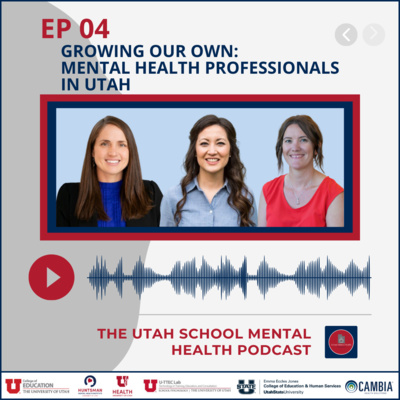
Growing Our Own: Mental Health Professionals in Utah
If you are a mental health provider based in Utah or have worked in Utah, then you know the increasing shortage of mental health professionals we are seeing- for various reasons. The mental health status of our state continues to be featured on the headlines of various news outlets. For instance, just early last year (2022) there was an article citing some Utah public health data, and it mentioned that we as a state are experiencing consistent peaks in the rates of self-reported lifetime depression in comparison to the national rate. We have plenty to talk about and much to unpack. For that I have the honor of hosting three mental health professionals who continue to do tremendous work in the field.
Meet our guest speakers
Jessie Koltz: Licensed practicing school counselor from 2013-2022 in various settings and is currently the program director of the School Counselor Education M.Ed. program. Her research interests include supporting at-risk and minority youth populations with adventure-based counseling and involvement in sports while integrating mindfulness based interventions, the access for youth education and learning through technology-based mental health interventions, stigma as a barrier to change for at-risk or minority student-athlete youth populations, school counselor education program accreditation, program evaluation of school counselor education programs, professional dispositions competency assessment of school counselors in training, and mindful social emotional learning within higher education.
Elizabeth Klc: Director for the Utah Substance Use and Mental Health Advisory Council (USAAV+), an advisory council to the Governor's Office. The mission of the USAAV+ Council is to create and coordinate a comprehensive strategy to eliminate substance use and mental health disorders throughout Utah. She works with many different groups to represent the interests and concerns of behavioral health professionals and populations and advises the Governor and Legislature on proposed policy and works with the USAAV+ Council to generate unity for the State's ongoing efforts to best address behavioral health issues.
Leah Colburn: Member of the Utah Department of Human and Human Services-Office of Substance Use and Mental Health. As the Administrator of Children, Youth and Family Programs, she oversees mental health strategies for children and youth. Leah has previously worked in community mental health, providing a continuum of behavioral health supports and services to at-risk and underserved youth and families in Utah. While working in community mental health, Leah supervised school-based mental health programs, intensive wraparound in-home programs, and crisis intervention.
Music by: Zachary W. Bacon, University of Utah music composition student
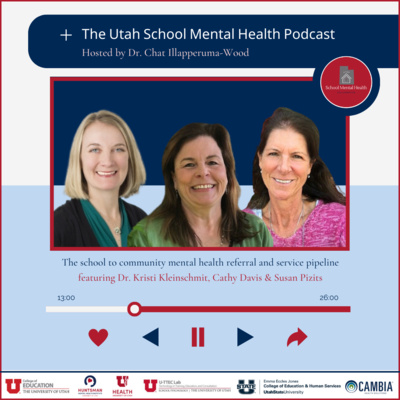
The School to Community Mental Health Referral & Service Pipeline
Community mental health providers and services that are just as critical as the school mental health providers and services and can be a very helpful resource to address the need for services and shortages of providers. It’s so important to divide and conquer- because really it takes a village to support student mental health and well-being and do this important work- and we definitely cannot do it alone! Join us as we talk about school to community mental health referrals and service pipeline.
Meet our guest speakers
Cathy Davis, MA.Ed: Certified QPR Trainer, safeTALK trainer, CONNECT postvention trainer, Youth Mental Health First Aid trainer, and PREPaRE (NASP) trainer. She has served as the current Suicide Prevention Specialist at the Utah State Board of Education since 2014. She has training in eating disorders, grief counseling, trauma-informed care and is certified with the American Association for Suicidology as a school suicide prevention specialist.
Dr. Kristi Kleinschmit: Assistant Professor in the Department of Psychiatry, at the University of Utah School of Medicine, and has served in many clinical roles caring for children, adolescents, and young adults with mental illness. She is a consulting psychiatrist to primary care providers across the state of Utah through the CALL-UP psychiatric consultation line. Along with Huntsman Mental Health Institute, she is partnering with the Department of Educational Psychology to develop School Mental Health programs including psychiatric services.
Susan Pizitz: Licensed clinical social worker and has worked in Salt Lake County as a school-based therapist with at-risk and underserved youth and families. Susan is a licensed school educator in The State of Utah with a K-12 social worker endorsement and has worked for Canyons School District for the past 3 years as a Mental Health Specialist in the Special Education Department. Susan has extensive clinical experience in working with youth and families who are impacted by trauma, anxiety, depression, and behavioral dysregulation and is passionate about working collaboratively with school teams and families in identifying supportive mental health resources in the their local community.
Music by: Zachary W. Bacon, University of Utah music composition student
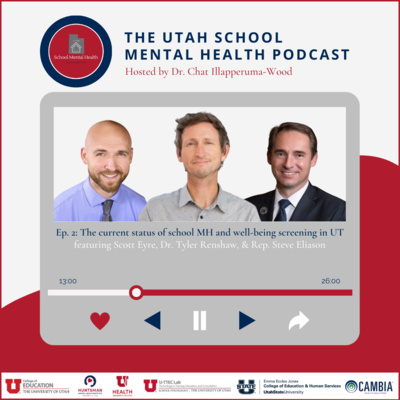
The Current Status of School Mental Health & Well-Being Screening in Utah
Mental health screening is without a doubt a critical component of a comprehensive school mental health system and is also a process that captures those students who perhaps may fall back - those who go unnoticed or aren't referred by their teachers or parents. Join us as we talk about the current status on mental health and well-being screening in Utah schools.
Meet our guest speakers
Dr. Tyler Renshaw: Associate Professor and Director of the School Psychology Program at Utah State University. He holds a doctoral degree in Combined Clinical / Counseling / School Psychology from the University of California at Santa Barbara. Dr. Renshaw directs the USU School Mental Health Lab, which conducts research on how to improve the accessibility and quality of mental health services in K-12 school settings.
Representative Steve Eliason: Served in the Utah House of Representatives since 2011 and currently serves as the House Chair of the Public Education Appropriations Committee. Rep. Eliason resides in Sandy Utah with his wife and six children. He has passed over 100 bills during his tenure in the Utah Legislature on various topics ranging from homelessness to education and has sponsored approximately 40 bills relating to suicide prevention and mental health to help improve the lives of people with a mental illness.
Scott Eyre: Currently works at the Office of Substance Use and Mental Health (formerly the Division of Substance Abuse and Mental Health) as the School Based Mental Health Specialist and acts as the liaison between the Office of substance use and MH and the State Board of Education. Scott holds a Bachelor's degree in Psychology from UVU and a Masters in Social Work from the University of Utah. He is a part of the School Safety Center Leadership team which works to identify evidence-based approaches that increase the physical and psychological safety of students and improve overall school climate.
Music by: Zachary W. Bacon, University of Utah music composition student
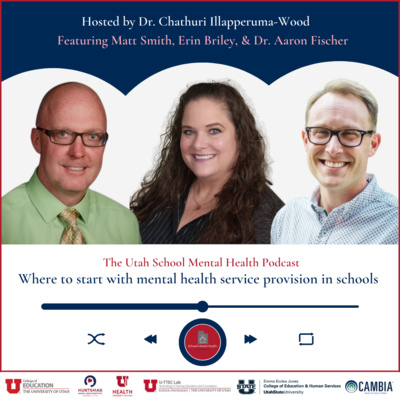
Where to Start with Mental Health Service Provision in Schools
A lot of schools are in different places with their mental health infrastructure. Some schools have really robust systems set up while other schools are piloting or thinking of piloting these service delivery models. Join us as we explore mental health service provision and models in Utah schools.
Meet our guest speakers
Matt Smith: Bryant Middle School Principal. In the fall of 2008, Matt helped to open Salt Lake Center for Science Education (SLCSE). Matt served as assistant principal for three years and is currently finishing his second year as principal.
Erin Briley: School Mental Health Coordinator for the Mountain Plains Mental Health Technology Transfer Center Network (MHTTC) as well as a Technical Assistant Associate for the Western Interstate Commission for Higher Education's Behavioral Health Program.
Dr. Aaron Fischer: Dee Endowed Professor of school psychology, adjunct associate professor of psychiatry, and co-director of the University of Utah Huntsman Mental Health Institute's School Mental Health Collaborative.
Music by: Zachary W. Bacon, University of Utah music composition student