Big Shift For Small Farms - Australian Agriculture and Regenerative Farming
By NSW Local Land Services
Produced by the @growloveproject with NSW Local Land Services, through funding from the Australian Government's National Landcare Program.
We acknowledge the First People of this land throughout Australia and recognise their connection to land, waters and community. We pay our respects to elders past, present and emerging.


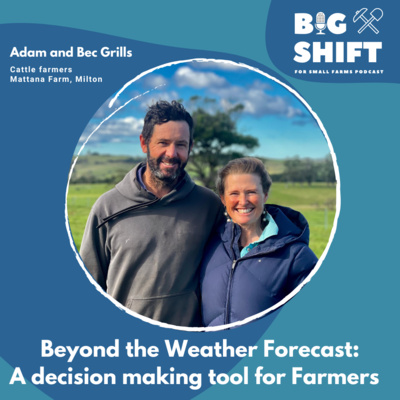
Beyond the Weather Forecast: A decision making Tool for Farmers
What if farmers could better understand what's happening beneath their feet? And could that information help them make better decisions when seasons don't go to plan?
In this episode, we explore Farming Forecaster, a free online tool that combines soil moisture, pasture growth and seasonal information to help farmers make more informed management decisions.
We visit Mattana Farm near Milton on the NSW South Coast, where Bec and Adam share how a local soil moisture probe has helped them navigate drought, fire, flooding rains and difficult livestock decisions.
Whether you're a data enthusiast or simply looking for another tool to support decision-making, this episode offers practical insights into using information alongside experience and intuition on farm.
Featured Guests
Bec and Adam – Mattana Farm, Milton NSW
Matt Lieschke – Agricultural Extension Officer, Local Land Services
Phil Graham – Agricultural Consultant
Episode Guide
(00:00) Farming through drought, fires and changing seasons
(06:00) Why soil moisture and temperature matter
(07:30) Using data to make tough stocking decisions
(08:30) How Farming Forecaster helps manage climate variability
(11:30) Exploring the website, probes and pasture forecasts
(16:00) Setting trigger points before conditions deteriorate
(24:30) Back on the farm: confidence, confirmation and practical advice
Useful Links
This episode is supported by the Australian Government through funding from the Natural Heritage Trust under the Climate-Smart Agriculture Program and delivered by South East Local Land Services, a member of the Commonwealth Regional Delivery Partners panel. Views and opinions expressed herein do not necessarily reflect those of Local Land Services or the Australian Government.
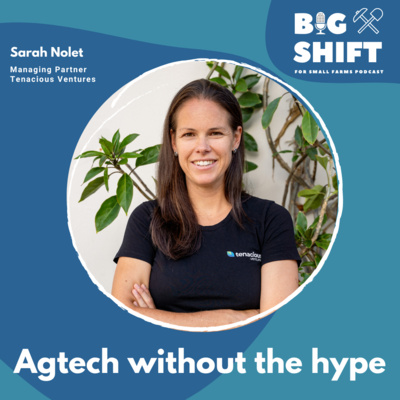
AgTech Without the Hype: What Actually Works on Farm
Can technology really help farmers build resilience in an increasingly unpredictable climate — or are we getting distracted by shiny new tools?
In this episode, we head to Twynam Farm in NSW to hear directly from farmers trialling agtech including virtual fencing, livestock monitoring and regenerative grazing systems.
Featuring conversations with Sarah Nolet and Susan Orgill, we explore how agtech can support climate resilience, soil health and better farm decision-making — while also asking where the risks and limitations lie.
We also hear from Camilla Beck and producers attending the Twynam field day, grounding the conversation in practical, on-farm experience rather than industry hype.
From virtual fencing and livestock monitoring to broader questions around profitability, labour and resilience, this episode asks: what technology is actually worth adopting on farm — and what problems should agtech really be solving?
Featured Talent & Links
- Sarah Nolet - Managing Partner, Tenacious Ventures
Tenacious Ventures
- Susan Orgill - Chief Scientist, Impact Ag Australia
Impact Ag Australia
- Camilla Beck - Executive Officer, Tablelands Farming Systems
Tablelands Farming Systems
- Johnny Kahlbetzer - CEO, Twynam Group
Climate Smart Farming Series - AgTech to manage climate risks and maximise return on infrastructure investment
https://open.spotify.com/episode/0e9xssrvNDOxqNjnkTnokc?si=iJLKN7cPSvKBi5RGXmQxbQ
Episode Guide
- (00:00) Why agtech promises deserve closer scrutiny
- (02:45) Productivity versus resilience in modern farming systems
- (05:20) Farmers explain pressures driving technology adoption
- (09:15) Optiweigh trials and livestock monitoring in practice
- (11:45) Virtual fencing and rotational grazing with Halter collars
- (19:05) Susan Orgill on evidence, soil health and farmer intuition
- (24:00) Sarah Nolet on solving real problems, not symptoms
This episode is supported by the Australian Government through funding from the Natural Heritage Trust under the Climate-Smart Agriculture Program and delivered by South East Local Land Services, a member of the Commonwealth Regional Delivery Partners panel. Views and opinions expressed herein do not necessarily reflect those of Local Land Services or the Australian Government.
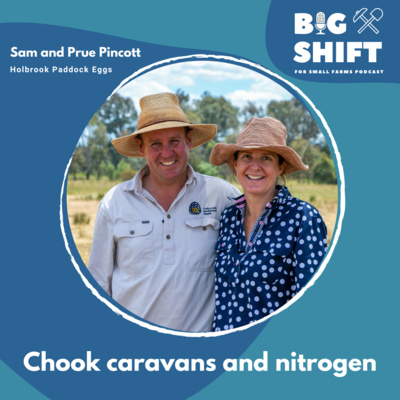
Chicken Caravans, Nitrogen & Smarter Farming Systems
What if your chickens could do more than just lay eggs? In this episode, we explore how mobile chook sheds can improve soil health, boost pasture growth, and reduce fertiliser costs through better nutrient cycling. Featuring insights from farmers and soil experts, this episode unpacks the nitrogen cycle, pasture recovery, dung beetles, and practical tips for building healthier, more profitable farming systems.
Key episode moments
[00:02:00] Rising fertiliser costs forced a new approach.
[00:04:00] The business started with 50 chooks in a caravan.
[00:09:00] Chicken manure improves nitrogen and soil health.
[00:10:00] Nitrogen efficiency is low without good management.
[00:18:00] Moving sheds regularly helps control manure load.
[00:22:00] Dung beetles help spread nutrients naturally.
[00:28:00] Changing rainfall affects pasture recovery times.
[00:30:00] Start small and build the system slowly.
Extra Show Notes Links
Clean Coastal Catchments Program nitrogen and dairy pasture video:
https://www.youtube.com/watch?v=uq--upG4xXs
NSW DPI fact sheet on chicken manure use in pastures in the associated links with the podcast:
Sam and Pru Pincott’s pasture-raised egg enterprise holbrookpaddockeggs.com.au
Watch a film we made about them
youtube.com/watch?v=YqQjQ_IL6mI
Virginia Mall’s regenerative mixed farming operation gracespringsfarm.com.au
Dung Beetles Podcast Episode – The Big Shift for Small Farmsopen.spotify.com/episode/2Yi2M7FK0JZtmNulR6vKkr?si=bmWzC9iaSqCOe7FDhbLZtA
If you enjoyed this episode, please subscribe, share it with a fellow horse owner, and leave a review — it helps us continue bringing these important conversations to life.
Produced by Grow Love Project and hosted by NSW Local Land Services. Supported by the Australian Government through funding from the Natural Heritage Trust under the Climate-Smart Agriculture Program. Views and opinions expressed herein do not necessarily reflect those of Greater Sydney Local Land Services or the Australian Government.

Pick Your Own: Profit, Pressure & People on Small Farms
What if you could add value to your farm without scaling production? In this episode, we explore pick-your-own as a diversification strategy—covering the realities, the opportunities, and what farmers need to know before opening the gate.
Key episode moments
(00:00) Is pick-your-own actually more profitable than wholesale?
(01:30) From city life to farming: buying a rundown blueberry farm with no experience
(04:30) COVID pivot: opening the gates and inviting the public in
(08:30) Why customers—not strategy—often drive the shift to PYO
(14:00) Burnout from farmers markets → “people are paying me to pick my fruit”
(15:30) Location matters—but people will travel for the experience
(17:30) The reality of customers: education, behaviour & managing expectations
(20:00) Does it stack up? Labour savings vs crop loss and margins
(29:30) Marketing that works: social media timing + a strong website
(41:30) Final advice: start small, ask for help, and know if it suits your personality
Read the full transcript
https://docs.google.com/document/d/1vvs2_PqBmqMlhXEjoZjc3Ul332DDtBl2/edit?usp=sharing&ouid=103831811474414598304&rtpof=true&sd=true
Explore more from our guests below:
Want more info about our pick your own guide. Click the link below:
https://forms.gle/M4uShQbCU954w2JEA
If you enjoyed this episode, please subscribe, share it with a fellow horse owner, and leave a review — it helps us continue bringing these important conversations to life.
Produced by Grow Love Project and hosted by NSW Local Land Services. Supported by the Australian Government through funding from the Natural Heritage Trust under the Climate-Smart Agriculture Program. Views and opinions expressed herein do not necessarily reflect those of Greater Sydney Local Land Services or the Australian Government.
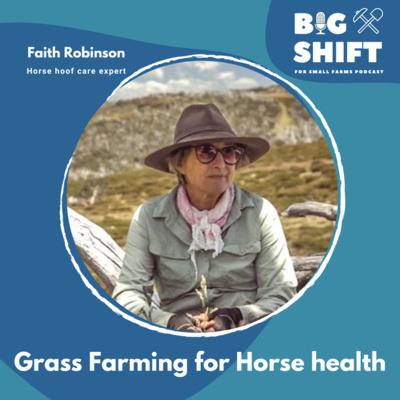
Grass Farming for Horses: Regenerative Pastures, Movement and Health
The episode urges horse owners to shift from viewing land as turnout to thinking like “grass farmers,” linking soil biology, plant diversity and grazing decisions to horse health.
We hear from horse behaviour expert Jane Myers who explains how separating horses and giving constant paddock access drives fence-walking, overgrazing and worn-out land, and she shares a simple yet transformative pasture paddock setup with her Equicentral system.
Hoof care professional Faith Robinson redesigned her NSW property with a track and laneways to boost movement, choice, and pasture recovery.
Agroecologist Nicole Masters links soil biology and plant diversity to nutrition, hoof and behavioural issues and urges owners to get curious by digging and reading “weeds” as indicators, and promotes diverse browse and nutrition supplements to reduce reliance on routine chemical worming.
Key episode moments
(00:00) Grass Farmer Mindset
(00:40) Meet the Guests
(01:48) Faiths Property Transformation
(03:24) From Bored Horses to Choice
(06:43) Jane on Behavior and Overgrazing
(09:27) Nicole on Pasture Diversity
(11:32) Soil Biology Basics
(13:13) Weeds as Soil Clues
(15:55) Rest and Second Bite Rule
(17:13) Stubby Test and Laminitis
(18:54) Equicentral System Explained
(21:52) Faiths Track and Laneways
(21:30) Design for Movement and Browse
(28:05) Rethinking Worming
(32:57) Manure Management and Dung Beetles
(38:38) Resilience in Drought and Flood
(43:19) Wrap Up and Resources
If this episode sparked new ideas about horse care, grazing, and land stewardship, you can explore more from our guests below:
Founder of Equiculture and educator in regenerative horse and land management.Learn more about the Equicentral system and Jane’s courses:Free Equiculture mini-course: equiculture.net/equiculture-free-mini-course
Agroecologist and soil educator helping landholders understand what’s happening beneath the surface.Explore Nicole’s Soil Horse Course and other training programs:integritysoils.com/products/soil-horse-course
Hoof care professional and horse owner sharing her real-world journey into regenerative horse management.tranquilisland.com.au
If you enjoyed this episode, please subscribe, share it with a fellow horse owner, and leave a review — it helps us continue bringing these important conversations to life.
Produced by Grow Love Project and hosted by NSW Local Land Services. Supported by the Australian Government through funding from the Natural Heritage Trust under the Climate-Smart Agriculture Program. Views and opinions expressed herein do not necessarily reflect those of Greater Sydney Local Land Services or the Australian Government.
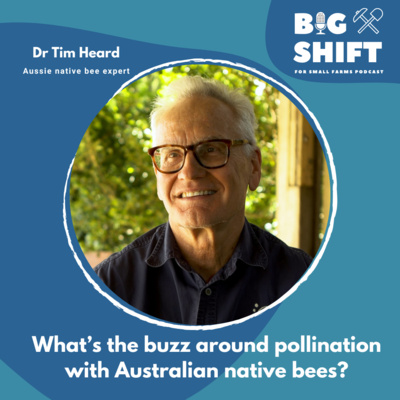
What' s the buzz around pollination with Australian native bees?
Depending on the time of day you're reading this, chances are you have a cup of tea, coffee or glass of wine in hand. And so you are already relying on pollination, and that's what this episode's all about because without healthy pollinators, so many of the foods and beverages we love simply wouldn't exist.
In the latest episode of The Big Shift for Small Farms Podcast, we explore how pollination underpins our food system and why its future matters to us all. We visit Bill Shields’ apple orchard in Bilpin to hear about a mysterious event that has left him with virtually no apples on his trees this season.
We'll sit down with Native Bee expert Dr. Tim Heard, who spent his career uncovering the hidden world of Australia's native bee pollinators.
And in the wake of the varroa mite, we also hear from someone who's been on the ground with farmers and beekeepers, learning from their experiences supporting their recovery, and helping chart a path forward for resilient pollination into the future.
Featured in this episodes:
Bill Shields - Apple farmer, Shields Orchard Bilpin (shieldsorchard.com)
Dr. Tim Heard - Australian native stingless bee expert (sugarbag.net)
Emily Noordyke - Project officer, National Varroa Mite Management Program (varroa.org.au)
Produced by Grow Love Project and hosted by NSW Local Land Services. Supported by the Australian Government through funding from the Natural Heritage Trust under the Climate-Smart Agriculture Program. Views and opinions expressed herein do not necessarily reflect those of Greater Sydney Local Land Services or the Australian Government.
Ecological Weed Management - Regenerative practices
Episode Title: Ecological Weed Management
Host: Edgars Greste
Guest: Kim Deans, Agro-ecologist (with special contributions from Alexia Martinez & Kym Green)
In this episode of The Big Shift for Small Farms, Edgars Greste takes a deep dive into the often-overlooked subject of weeds — and how thinking differently about them can transform your small farm. Joining him is agro-ecologist Kim Deans, who challenges traditional chemical-based weed control, and instead advocates for a holistic weed-management strategy grounded in soil health, biodiversity and sustainable farm practices.
You’ll also hear from farmers Alexia Martinez and Kym Green as they share firsthand experiences of integrating compost, cover-crops and natural remedies into their weed-control practices — showing how a small-farm operator can manage weeds and build a healthier ecosystem at the same time.
Why weeds aren’t just pests — they are indicators of underlying soil, pasture or ecosystem health issues.
How to shift from a reactive “spray-and-pray” mindset to a proactive system-based approach focusing on soil biology, cover crops, grazing and pasture competition.
Practical strategies for small farms in Australia: implementing cover crops, compost, rotational grazing and non-chemical weed suppression methods.
Real-world farm stories: how Alexia Martinez and Kym Green are balancing weed control with regenerative practices on their properties.
00:00 – 05:00 → Introduction: why weed management needs a rethink in small-scale agriculture
05:01 – 15:00 → Guest segment: Kim Deans’ journey from traditional farming to agro-ecology
15:01 – 30:00 → Core principles: ecosystem thinking, soil health and weeds as signals
30:01 – 45:00 → Practical tactics for small farms: cover crops, compost, grazing, and timing
45:01 – 55:00 → Farmer voices: Alexia Martinez & Kym Green share their stories
Biodynamic Agriculture Australia Ltd: https://biodynamics.net.au/
Kym Green: https://www.facebook.com/Kymgreenlenswood/
Free Guide: Weeds as Indicators of Soil Health (via Reinventing Agriculture) Reinventing Agriculture
Where to from here?
Walk a paddock, and document which weeds are present, how dense they are — and ask: What might they be signalling about soil health or pasture competition?
Choose a paddock to trial a cover-crop (or increased ground cover) this season. Compare weed pressure at the end of the season with a part of the paddock left under current management.
Talk to a neighbour/mentor/agribusiness about integrating grazing or compost strategies to suppress a particular persistent weed species you face.
Then, set a reminder: revisit the same paddock in 3 months, note changes and score weed pressure on a scale of 1-10. Reflect: What changed? What still needs adjusting?
On smaller farms, conventional large-scale weed-control methods (heavy chemical sprays, large machinery) may be less economical or sustainable. By adopting an ecological approach, you gain:
Improved soil health that supports your desired plants & crops, not just suppression of weeds.
Reduced reliance on chemical inputs and lowered costs — especially relevant in tight-margin scenarios.
More resilient systems: healthier soils and beneficial plant cover help your farm bounce back from droughts, floods or other extreme conditions.
As Kim Deans reminds us: “Weeds are not just your enemy — they’re nature’s message.” When you begin to listen, to interpret what those weeds are telling you about your soil, pasture and farm system, you shift from reacting to guiding your system. This isn’t about perfection — it’s about progress, one paddock and one season at a time.
—
Thank you for tuning in. If this episode resonated, please subscribe, leave a review wherever you listen to podcasts, and share it with a fellow small-farm operator or land manager who might benefit. Until next time — keep observing, adapting and growing.
Changing from Traditional to Regenerative Farming
In this episode of the Big Shift for Small Farms Podcast, host Edgars Greste chats with dairy farmer Andy Hanna, whose farm is located in the heart of greater Sydney, amidst the growing impact of suburban sprawl. With farming pressures like unpredictable climate conditions and tight financial margins, Andy’s story is a powerful example of adapting and thriving against the odds.
Edgars recently had the chance to visit Andy’s farm and was impressed by the work and evolution of his farming practices. Andy’s approach to low-input, ecological farming focusing on rotational grazing, boosting pasture biodiversity, and working with natural nutrient cycles, offers valuable, practical examples of how to make a big shift toward sustainability. This conversation is full of insights on building resilience into farming systems while supporting the environment and the community.
Thank you to our guest, Andy Hanna, featured in this episode.
For more information:
AG360 Rotational Grazing Planner - https://ag360.com.au/#!/out
Multispecies pastures podcast episode - https://creators.spotify.com/pod/profile/the-big-shift/episodes/Multispecies-Pastures-e2i8dgt
Soil Amendments podcast episode (featuring Dairy farmer Gavin Chittick) - https://creators.spotify.com/pod/profile/the-big-shift/episodes/Understanding-Soil-Amendments-to-Boost-Soil-Fertility-e2go7l2
Produced by Grow Love Project and hosted by NSW Local Land Services. Supported by the Australian Government through funding from the Natural Heritage Trust under the Climate-Smart Agriculture Program. Views and opinions expressed herein do not necessarily reflect those of Greater Sydney Local Land Services or the Australian Government.
Natural Capital Insights for Regenerative Land Management Practices
In this episode of the Big Shift for Small Farms podcast, we explore the idea of natural capital—the economic and environmental value of nature. Joined by natural capital advisor Madeleine Florin and farmers Ned Long and Rhiannon Phillips, the conversation highlights regenerative land management practices, the advantages of enhancing natural capital, and new market opportunities. The episode includes practical examples and discusses the impacts on farming, communities, and personal well-being, underscoring the link between environmental stewardship and economic resilience.
Thank you to our guests featured in this episode:
Madeleine Florin
Ned Long
Rhiannon Phillips
For more information:
NSW LLS - Natural Capital: https://www.lls.nsw.gov.au/help-and-advice/natural-capital
NSW LLS - Natural Capital Service Finder:
Natural Capital service finder - Local Land Services (nsw.gov.au)
Mountains Gourmet (Rhiannon’s market garden and services): https://www.mountainsgourmet.com/
Farming for the Future: https://farmingforthefuture.org.au/
Produced by Grow Love Project and hosted by NSW Local Land Services
Soils and Pasture Management of the NSW South Coast
Welcome to an insightful podcast episode uncovering the intricate world of Southeast New South Wales' diverse soils. Come on a journey with Di and Steven in their transition from dairy to beef production by focusing on soil health and the impact of soil quality on farming practices. We’ll hear from Roy Lawrie, a seasoned soil expert, and Andrew Britton, former Small Farms Coordinator for the South Coast region, as they demystify the complexities of soil management. We’ll learn about crucial topics such as the significance of topsoil and subsoil tests, the variability in soil profiles across landscapes, the persistent challenges of weed management, and the presence of acid sulfate soils. This episode equips you with invaluable tips on soil and weed management, aimed at elevating farmers' ability to enhance land health and embrace regenerative farming practices.
Thank you to our guests featured in this episode:
Diana Ferguson and Stephen Shipton
Roy Lawrie
Wayne Brown
Andrew Britton
For more information:
NSW Soils Knowledge Network - https://www.nswskn.com/
Produced by Grow Love Project and hosted by NSW Local Land Services
Soils for Life Conference
Ever wondered about regenerative agriculture and the impacts it can have on farmers? Join us as we learn about real life experiences shared by seasoned farmers at the recent Soil Stewardship Summit near Yass, NSW. Over two enlightening days, participants explored the concept of regenerative agriculture, discussing key topics such as tapping into indigenous wisdom, enhancing drought resilience, transitioning from high production to natural methods, and prioritizing soil health for improved yields and healthier societies. The stories embody values of patience, gratitude, and deep respect for nature, offering valuable inspiration for those considering or embarking on the journey towards sustainable farming practices. Tune in for a thought-provoking discussion that encapsulates the transformative power of regenerative agriculture and a return to natural processes.
Thank you to our guests featured in this episode:
Eli Court (Soils for Life)
Paul Girrawah House
Rhonda Daly
Colin Seis
Garry Kadwell
David Marsh
For more information:
- Previous Big Shift episode on regenerative farmers - tiny.cc/bigshiftregen
- Soils for Life - https://soilsforlife.org.au
- Paul Girrawah House - https://www.linkedin.com/in/paul-house-57055860/?originalSubdomain=au
Produced by growloveproject.com and hosted by NSW Local Land Services
The beauty of microbiology in the soil
Biology drives nearly all processes in our soil. From structure and water infiltration, to nutrient cycling and disease suppression. Until recently the biological function of soil has largely been overlooked in favour of soil physics and chemistry. So to find out more about the beauty of bugs we spoke with soil microbiologist, Kelvin Montagu
Thank you to our guest featured in this episode:
Kelvin Montagu
For more information:
Produced by Grow Love Project and hosted by NSW Local Land Services
Multispecies Pastures
Curious about the buzz surrounding multi-species pastures and its game-changing role in regenerative agriculture? Join us to hear expert insights from Sarah Fea, an experienced agroecologist, who explores the diversity of advantages that multi-species brings to the table. We look into the significance of improving soil health, biodiversity, efficiency of resources, pest control, and creation of resilient landscapes. Gain valuable insights from on-field farmers as they share their journeys experimenting with multi-species pastures, revealing the substantial benefits they've reaped through the transition to diverse pastures.
Thank you to our guests featured in this episode:
Sarah Fea
Adam and Jody Turner
Greg Mumm
For more information:
Produced by Grow Love Project and hosted by NSW Local Land Services
Knowing Your Soils - Sydney region
This episode explores the importance of soil and soil management for agriculture and the environment, focusing on the soils of the Sydney region. Experts from the New South Wales Soil Knowledge Network share their expertise on topics such as geology, soil formation, soil types, erosion, and assessing soil health. The conversation highlights the role of organic matter, irrigation, and soil samples in managing different soil types. Listeners will gain a better understanding of the value of soil and practical tips for improving soil health. Let's make the world greener and healthier, one soil particle at a time!
Thank you to our guests featured in this episode:
Greg Chapman
Tony Voller
Madeleine Florin
Cathy Sherry
For more information:
Produced by Grow Love Project and hosted by NSW Local Land Services
Macrobiology in the Soil - Dung Beetles
In this episode, get ready to dig into the quirky world of dung beetles and discover how these little champions are like the superheroes of soil health on farms! Join us and our guests as we chat about the fantastic benefits dung beetles bring to Australian farmers – from reducing water runoff to boosting pasture growth and improving soil in grazing systems, to keeping pests in check, and even mastering the art of carbon sequestration. These remarkable critters prove that sometimes, in the smallest packages, you find the mightiest heroes for our planet's well-being.
Thank you to our guests featured in this episode:
Russ Barrow
Ed Hogan
Keri Chittenden
Michael McDonald
For more information:
Produced by Grow Love Project and hosted by NSW Local Land Services
Understanding Soil Amendments to Boost Soil Fertility
In this episode, we explore soil amendments and their role in enhancing soil fertility. Accompanied by farmers from Kangaroo Valley, we delve into their strategic use of compost and diverse amendments to enhance soil health. Former Senior Agricultural Advisor Ed Hogan presents a comprehensive soil biology demonstration, offering invaluable insights for the farming community - recognising the significance of tailoring agricultural approaches to meet the distinctive needs of each soil and steering clear of a generic 'one-size-fits-all' methodology. Tune in to discover which amendments could potentially elevate the soil fertility on your farm.
Thank you to our guests featured in this episode:
Brad Hawthorne
Gavin Chittick
Edmund Hogan
For more information:
Produced by Grow Love Project and hosted by NSW Local Land Services
Caring for Riparian Zones
Riparian Zones play an integral role in the Australian landscape - from cultural heritage to agriculture, recreation, and providing habitat for aquatic and terrestrial animals. These areas are crucial for filtering water, preventing erosion, and supporting the overall productivity of the surrounding landscape. They also provide grazing, shelter, and access to water for livestock.
Development and agriculture can pose a potential threat to riparian zones. Clearing, overuse, and uncontrolled stock access are some activities that can lead to erosion, habitat loss, and reduced water quality. But there are ways to look after this unique landscape.
In this episode, we join three individuals who give us tips on restoring riparian land on your property. As we journey along the creek, we may glimpse one of Australia’s most shy and unique creatures.
Thank you to our guests featured in this episode:
Alexia Martinez - farmer
Michelle Ryan - Senior Lecturer in ecology and environmental Science at Western Sydney University
Lori Gould - Program Manager of the Australian River Restoration Centre
For more information or to get involved:
Australian Platypus Conservancy
Australian River Restoration Centre
Cattai Hills Environment Network (CHEN)
Hosted by Edgars Greste
Produced by Grow Love Project and hosted by NSW Local Land Services
Conservation agreements benefitting private landholders
Many landholders have been promoting biodiversity and wildlife conservation on their property for many years. Not only is this beneficial for the environment, but through conservation agreements, landholders benefit financially from protecting their patches.
Landholders can be involved in a variety of different programs and conservation agreements. One of the main aspects is landholders need to have native vegetation in good condition on their land. In terms of size, smaller farms can collaborate to create larger parcels that may be eligible for financial compensation.
In this episode, we’ll hear from private landowners who have been managing biodiversity and promoting wildlife conservation on their land for years - and they have benefited from it in many ways.
Thank you to our guests featured in this episode:
Bev Debrincat - Chair of Greater Sydney Landcare, landholder
Xuela Sledge - Koala Project Officer with Greater Sydney Landcare
Matt Carr - acting director of the Biodiversity Conservation Trust
Jocelyn Howden - founder of the Glenorie Wildlife Refuge
For more information or to get involved:
Landholder guide to conservation agreements
Biodiversity Conservation Trust
Hosted by Edgars Greste
Produced by Grow Love Project and hosted by NSW Local Land Services
Citizen Science helping to inform natural resource management
Citizen Science has been around for a long time. It has allowed vast amounts of data to be collected and analysed within a relatively short period by getting members of the public to participate in scientific research.
This research is invaluable as it helps to inform natural resource management, increase environmental protection and inform policy and decision making. It also benefits individuals as they can engage in research and provide public input.
There are numerous citizen science opportunities for landholders to get involved in, whether it be about frogs, tree hollows, scats, or even ferals - there is something for everyone.
Join us as we speak with three motivated individuals working in this space across diverse topics and landscapes, from water to earth to sky.
Thank you to our guests featured in this episode:
Lilly Schwartz - founder of the Hills Hornsby Rural Koala Project
Jessica Lumbroso - Land Care Coordinator and Streamwatch Coordinator for the Greater Sydney Land Care
Ben Humphries - Coordinator of the Southern NSW Birds on Farms Project
For more information or to get involved:
Hills Hornsby Rural Koala Project
Australian Citizen Science Association (in partnership with Atlas of Living Australia)
Hosted by Edgars Greste and Katie Meyer
Produced by Grow Love Project and hosted by NSW Local Land Services
Habitat connectivity for landscape resilience
Wildlife corridors are essential for the survival of animals. They also provide additional benefits for both the environment and agricultural productivity.
Unfortunately, habitat loss, fragmentation and degradation create immense challenges for animals as they struggle to reach food, water and shelter. But there are many things that landholders can do to improve habitat connectivity and increase wildlife conservation efforts. By planting more trees and creating corridors for animals, landholders contribute to landscape resilience and benefit in many ways by preventing soil erosion, improving crop pollination and providing shelter for stock.
Join us in this episode as we journey through three different landscapes and learn about initiatives protecting and restoring our landscapes and natural systems, improving habitat connectivity and benefiting landholders.
Thank you to our guests featured in this episode:
Angie Fricker - Senior Land Services Officer with Greater Sydney LLS
Garry Watterson - Landholder
Gary Howling - Chief Executive Officer of the Great Eastern Ranges
Paul Madden - Project Officer with Community Environment Network
For more information or to get involved:
Hawkesbury-Nepean Landcare Network
Community Environment Network (CEN)
Hosted by Edgars Greste and Katie Meyer
Produced by Grow Love Project and hosted by NSW Local Land Services

Climate Smart Farming Series - Livestock Management to maintain production and resilience during extreme climate events
Livestock farming has been practiced for over 10,000 years, so understandably there are many different approaches, particularly when adapting to climate change. Climate change affects livestock production, both directly through heat stress and indirectly through effects on grassland and species distribution. Farmers are innovatively managing their livestock to improve productivity and reduce environmental impacts. The techniques vary, including rotational grazing, precision genetics, species stacking and intensive feeding systems. This episode features three farmers who share how, by implementing these management techniques, they have maintained production during extreme climate events, making their businesses more resilient.
Thank you to our guests
- Matthew Martin - Old Cobran Pastoral
https://www.dpi.nsw.gov.au/stories/m-martin
- Stacey Lugsdin - Warrendale
https://www.dpi.nsw.gov.au/stories/s-lugsdin
- Luke and Pia Winder - Tathra Place
https://www.dpi.nsw.gov.au/stories/lp-winder
Hosted by Edgars Greste and Matt Pierce
Produced by Grow Love Project for @NSWDPI and hosted by NSW Local Land Services #Bigshiftforsmallpodcast
*NSW DPI understands that successful adaptations will vary between locations, industries and business.

Climate Smart Farming Series - Biodiversity and ecosystem services for supporting climate resilient agricultural production
On the road again with Matt and Edgars. This time visiting farmers who have significantly injected life back into their farms growing wine, macadamias and cherries! Biodiversity is essential for ecosystem functions that support all life on Earth. Climate change significantly impacts biodiversity through the increase in the intensity and frequency of fires, storms, or periods of drought. Farmers combat and maintain healthy ecosystems by focusing on regenerative practices such as native plantings, increasing diversity, cover cropping, microbiology and integrated pest management. In this episode, be inspired by farmers who have improved their resilience by increasing whole ecosystem biodiversity on their farms to improve pest control, pollination and carbon sequestration.
Thank you to our guests
- Keith and Alistair Tulloch - Keith Tulloch Wines
https://www.dpi.nsw.gov.au/stories/ka-tulloch
- Ross Arnett - Malua Farm
https://www.dpi.nsw.gov.au/stories/r-arnett
- Chris and Lee Hall - Hall Family Orchards
https://www.dpi.nsw.gov.au/stories/cl-hall
Hosted by Edgars Greste and Matt Pierce
Produced by Grow Love Project for @NSWDPI and hosted by NSW Local Land Services #Bigshiftforsmallpodcast
*NSW DPI understands that successful adaptations will vary between locations, industries and business.

Climate Smart Farming Series - Building healthy soils that buffer against severe climatic events
Soil is one of the most undervalued substances on this planet, but farmers know that our future depends on the health of our soil. Maintaining healthy soils improves productivity and resilience on farms and also plays a role in tackling climate change by capturing and storing vast amounts of carbon. Recent climatic changes contribute to many soil issues like erosion, nutrient imbalance, water logging and loss of soil biodiversity. In this episode several farmers share their experiences of cover cropping, soil testing and using compost and organic fertilisers to improve soil health and structure and increase soil carbon for a more resilient farm and planet. Healthy agricultural soils allow functional biology (food webs) and chemistry (nutrient cycling) for efficient and sustainable productivity. Hear from 3 farmers implementing practices to sustain their soils and how they've buffered the impacts from sever climate events.
Thank you to our guests
• John and Juanita Hamparsum, Drayton Station
https://www.dpi.nsw.gov.au/stories/jj-hamparsum
• Peter and Darcy Skipworth, Currebah
• Justin and Pip Jarrett, See Saw Wines
https://www.dpi.nsw.gov.au/stories/jp-jarrett
Hosted by Edgars Greste and Matt Pierce
Produced by Grow Love Project for @NSWDPI and hosted by NSW Local Land Services #Bigshiftforsmallpodcast
*NSW DPI understands that successful adaptations will vary between locations, industries and business.
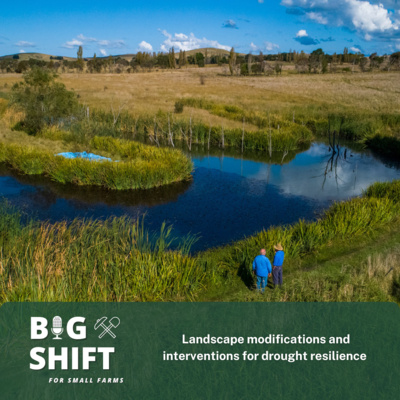
Climate Smart Farming Series - Landscape modifications and interventions for drought resilience
The #ClimateSmart series explores the diverse impacts of #ClimateChange on the landscape and farmers' own experiences in practically adapting their land, systems and businesses.
In this episode, we're looking at farmers who have used landscape modification including diversion banks, ponding, swales and leaky weirs to slow and store water flows during rainfall events. Along with restoring ground cover this has significantly reduce erosion and restored landscape function.
Thank you to the farmers, you can watch and read their stories here:
Scott Preisig and Belinda Scott, Merrylands Station, Kerrigundi, NSW
dpi.nsw.gov.au/stories/blake-preisig
Glenn Morris, Billabong Farm, Inverell, NSW
dpi.nsw.gov.au/stories/g-morris
Martin Royds, Jillamatong Farm, Braidwood, NSW
dpi.nsw.gov.au/stories/m-royds
Watch all the Climate Smart films:
dpi.nsw.gov.au/dpi/climate/digital-agriculture/farmer-stories
Your hosts Edgars Greste @growloveproject and Matt Pierce @NSWDPI
Producers Edgars Greste, Susannah Kable and Katie Meyer
Produced by @growloveproject for @NSWDPI and hosted by NSW Local Land Services #Bigshiftforsmallpodcast
*NSW DPI understands that successful adaptations will vary between locations, industries and business.

Climate Smart Farming Series - AgTech to manage climate risks and maximise return on infrastructure investment
The #ClimateSmart series explores the diverse impacts of #ClimateChange on the landscape and farmers' own experiences in practically adapting their land, systems and businesses. In this episode, we're looking at farmers who have adopted digital technology that have allowed them to improve their productivity, achieve efficiencies, respond to the climate risk, and adapt their enterprises.
Thank you to the farmers, you can watch and read their stories here:
Vito Mancini blood orange farm, Redbelly Citrus, Griffith NSW
https://www.dpi.nsw.gov.au/stories/v-mancini
Ewan and Kevin McAsh, Oyster Life Management on the Clyde River near Batemans Bay NSW
https://www.dpi.nsw.gov.au/stories/ke-mcash
Ian and Pru Pearce, Stoneleigh Orchard near Orange NSW
https://www.dpi.nsw.gov.au/stories/ip-pearce
Watch all the Climate Smart films: https://www.dpi.nsw.gov.au/dpi/climate/digital-agriculture/farmer-stories
Your hosts Edgars Greste @growloveproject and Matt Pierce @NSWDPI
Producers Edgars Greste, Susannah Kable and Katie Meyer
Produced by @growloveproject for @NSWDPI and hosted by NSW Local Land Services #Bigshiftforsmallpodcast
*NSW DPI understands that successful adaptations will vary between locations, industries and business.

These farm planning tools could save you time and money
You know that phrase if you fail to plan, you are planning to fail. Now, depending on which Wikipedia entry you read, either Winston Churchill, Benjamin Franklin or Aristotle or a bunch of other people said it. But the point is, planning is a good thing to do. It helps you identify and reach your goals, realise your vision for your property, and what lifestyle you want to leave. We've actually produced a few episodes on the topic. One on farm planning principles and planning for emergencies, which looks at flood and bushfire preparedness. But in this episode we're taking a look at a farm planning package of tools that Greater Sydney Local Land Services has produced for landowners and managers. It includes a workbook, self-assessment quiz and mapping tool to make this process easier. We'll hear from some new farmers who've trialed the tools to help them get their ideas out of their head and onto some paper or in the computer, and also help them think about stuff that wasn't even on their radar. But first we’re going to get some farm planning fundamentals from coach Kim Deans. Let's get planning.
The workbook and self assessment resources are available to download on the LLS website
https://www.lls.nsw.gov.au/regions/greater-sydney/key-projects/small-farms-network/property-planning-resources
Thank you to all our guests:
Richard Stephens and Madeleine Florin from Greater Sydney Local Land Services
Kim Deans https://www.reinventingagriculture.com.au/kim-deans
Kirrily Smith, Farmer
David Adderton, Farmer

Working with nature and environmental accounting on farm
#Agricultural production relies on natural ecosystems, but, the more we modify our landscapes, the less resilient they become, resulting in reduced production.
Balancing the needs of both is crucial to meet the demands of increasing yields without further compromising the environment. So how do we do this? Well, the good news is that #farming methods that work with nature can achieve great production outcomes and incentives for landscape restoration are available.
So in this episode we’ll talk to some passionate producers, ecologists and number crunchers about our environment’s true value and how land managers can be rewarded for working with nature.
With thanks to:
Anika Molesworth
https://www.anikamolesworth.com/
Nicole Masters
https://www.integritysoils.co.nz/
David Carr
http://stringybarkecological.com.au/
Adrian Ward
https://www.accountingfornature.org/
Rowan Foley
https://www.abcfoundation.org.au/
Produced by the Grow Love Project in collaboration with NSW Local Land Services
Soil carbon and carbon farming opportunities
Most of us know that increasing carbon in the soil has many benefits and with interest in carbon farming growing, our latest episode of The Big Shift Podcast explores how to increase carbon in the soil and the opportunities available for farmers.
First up in this episode we explore the science of soil carbon with Dr Susan Orgill followed by a chat with Dr Lorraine Gordon about her journey into carbon farming and how it could be the crop of the future.
Susan Orgill, Leader Soils R&D South at NSW Department of Primary
https://www.dpi.nsw.gov.au/about-us/research-development/staff/staff-profiles/susan-orgill
Cameron Smith, Farm Manager
Kate Carmichael, Soilkee
https://soilkee.com.au/
Lorraine Gordon
https://www.scu.edu.au/regenerativeag/about/team/

Working with weeds as indicators on farm
For most people, weeds are a dirty word. They’re often talked about as an undesirable plant in the wrong place. And whilst it's true that some species left unmanaged can cause ecological problems, what if weeds are actually trying to tell us something. Something about that place where they’ve shown up that we don’t know about yet. So in this episode we hear from weed whisperers and what they’re saying is don’t blame the messenger because the messenger might actually be part of the solution.
Thank you to all those who shared their knowledge with all of us:
Nicole Masters https://www.integritysoils.co.nz/
Hamish MacKay https://biodynamics2024.com.au/workshops/
James Barnet RCS https://www.rcsaustralia.com.au/
Clare Edwards https://www.lls.nsw.gov.au/regions/central-tablelands
The Greater Sydney Regional Weed Management Plan
https://tinyurl.com/yffmjv8d
https://plantnet.rbgsyd.nsw.gov.au/
Please listen, rate and share this episode. Thank you.
This podcast has been produced by the Grow Love Project with support from Greater Sydney Local Land Services, through funding from the Australian Government's National Landcare Program.
We acknowledge the First People of this land and recognise their connection to land, water and community. We pay our respects to elders past, present and emerging.

Managing animal pests on farm
We have dramatically changed the landscape by digging dams, introducing feral animals and clearing native habitat. These actions have created the perfect environment for certain species to thrive including mice, foxes and rabbits, which come with a range of challenges for farmers. So in this episode we’re going to hear about some of the ways we can control these pests and move closer to nature.
Please listen, rate and share the episode.
With thanks to the following people for sharing their knowledge in this episode:
Brian Wehlburg https://www.insideoutsidemgt.com.au
David Brook https://wildbnb.com.au
Lee Parker https://www.lls.nsw.gov.au/regions/south-east/key-projects/every-bit-counts/resources/pest-animals
Emma Sawyers https://www.dpi.nsw.gov.au/biosecurity
Peter West https://www.feralscan.org.au
Credits
This podcast has been produced by the Grow Love Project with support from Greater Sydney Local Land Services, through funding from the Australian Government's National Landcare Program.
We acknowledge the traditional custodians of this land throughout Australia and recognise their continuing connection to land, waters and community. We pay our respects to elders past, present and emerging.

Emerging Australian agricultural industries
Small scale farmers are faced with a lot of pressures, from climate change on farm to competition in the marketplace. In this episode we’re hearing from farmers and producers about Australian made emerging opportunities, from climate tolerant native bush foods to economically sustainable bespoke dairy products. Not only can they help farm business but also the broader community and our planet.
Guests featured in this episode include:
Cressida Cains, Dairy Cocoon https://www.pecoradairy.com.au/
Chris Andrew, Black Duck Foods https://blackduckfoods.org/
Josh Gilbert, Indigenous agriculturalist http://www.gilbertjoshuam.com/
Tim Wimbourne, Braidwood Food Company https://www.braidwoodfood.com/
Credits
This podcast has been produced by the Grow Love Project with support from Greater Sydney Local Land Services, through funding from the Australian Government's National Landcare Program.
We acknowledge the traditional custodians of this land throughout Australia and recognise their continuing connection to land, waters and community. We pay our respects to elders past, present and emerging.
Pasture and livestock recovery following a flood
Many of our listeners in NSW have been heavily impacted by recent flooding at the end of March this year. In the Hawkesbury-Nepean river region of Western Sydney, it caught many by surprise peaking at a staggering 12.9 metres, with water engulfing properties and homes.
So in this episode we’re bringing you a special recording at a field day on flood recovery hosted by Greater Sydney Local Land Services at their demonstration farm in April. Our producer Olivia Ralph was there to capture some insights from the event.
Thanks to Alana, Amy and Tom for sharing their stories.
Others featured in this episode:
Adam Little, Senior agronomist and livestock specialist - Ace Ohlsson Elders
Neil Griffiths, Agronomist and pasture specialist - Hunter Local Land Services
Richard Stephens, Regional Agriculture Landcare Facilitator - Greater Sydney Local Land Services
Stock that has been in floodwater should be monitored closely to ensure they are eating and watched for signs of disease.
Download a copy of our guide to assist landholders to care for livestock in flood https://bit.ly/39dHVc2
Please contact your local LLS veterinarian on 1300 795 299 for further advice, or if you notice any signs of disease or illness.
Credits
This podcast has been produced by the Grow Love Project with support from Greater Sydney Local Land Services, through funding from the Australian Government's National Landcare Program.
We acknowledge the traditional custodians of this land throughout Australia and recognise their continuing connection to land, waters and community. We pay our respects to elders past, present and emerging.
Planning for a farm emergency
In this episode we’re talking about emergency management. We’ll hear from field officers and researchers about the importance of making plans and keeping yourself in check. We will then chat to a farmer who’s using animals as a tool to reduce his fire risk. So let’s get planning.
Thank you to all our guests who featured in this episode:
Kirsty and Andrew Hambrook, Terrewah Farm - terrewahfarm.com.au
Linda Hanlon, Senior Land Services Officer, Local Land Services
Pet Passport - ses.nsw.gov.au/media/3665/greater-sydney-local-land-services_20pp-a5-booklet_kids-passport_generic.pdf
Mel Taylor, Associate Professor, Macquarie University
Blue Arc - Blue Mountains Animal Ready Community - facebook.com/groups/1045349658940538
Aaron Brocken, Harvest Farms - facebook.com/HarvestFarmsBilpin

Do you measure what matters on you farm?
Now according to The Economist Newspaper, the world’s most valuable resource is no longer oil, but data. And what makes it valuable is what we do with it. In this episode we’ll get some tips from farming consultants about how to use data to improve your management both in the paddock and on your balance sheet. And we’ll find out why owning a bird book is a sign that business is going well. Guests featured in this episode include:
Mark Gardner, Business consultant - Vanguard Business Services - vbs.net.au
Sarah Nolet, CEO - farmers2founders.com
Graham Hand, Farm consultant and educator - handfortheland.com
Greg Sharp, Managing Partner - Barrington Accounting - barringtonata.com.au
Episode produced by growloveproject.com
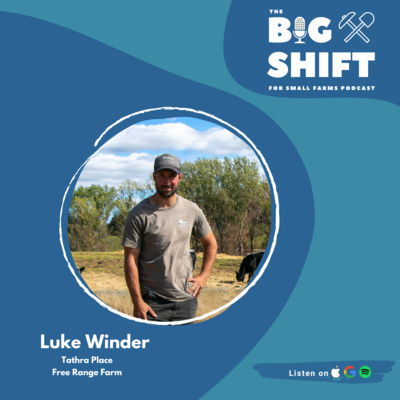
Farm branding to build connection
More and more consumers want to buy why you farm as much as what you produce. In this episode we’re looking at the power of your story. We’ll talk to farmers about their journey from small business to becoming a brand and we’ll hear about a platform that’s been built to help farmers not only sell their products but promote their farming practices.
Guests featured in this episode include:
Lisa Papallo, Marketing expert and founder of fairfoodie.com.au
Angus Maurice, Farmer - farmerbrownspasturedeggs.com.au
Erica and Hayden Watson - Farmers, Epicurian Harvest
Luke Winder, Farmer - tathraplacefreerange.com
Episode produced by growloveproject.com
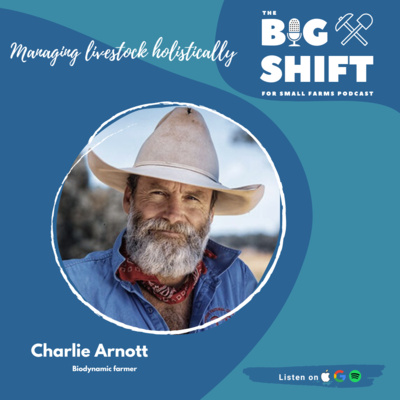
Managing livestock holistically
In Australia we grow a lot of introduced livestock species like cows, pigs, sheep and chooks. So in this episode we’re looking at how to care for your livestock mindfully. We’ll hear from a grazing management consultant about why looking after your landscape could save you big bucks and improve not only your livestock’s health but your own wellbeing too.
In this episode we hear from:
Anika Molesworth - Agroecology scientist and farmer - anikamolesworth.com
Charlie Arnott - Farmer - charliearnott.com.au
James Barnet - Grazing management consultant - rcsaustralia.com.au
Joe Kovacek - Farm manager - westernsydney.edu.au/environmental_sustainability/home/hawkesbury_farm
Cressida Cains - Farmer - pecoradairy.com.au
Episode produced by Grow Love Project
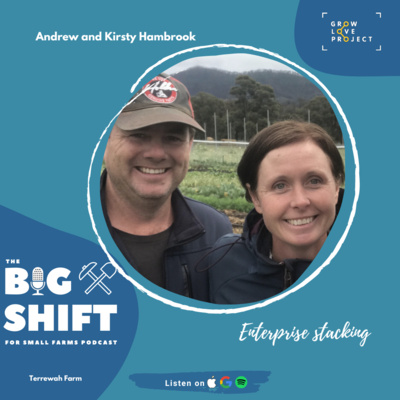
Farm Enterprise Stacking
We all know the dangers of having all your eggs in one basket. The good news is that there are plenty of creative ways to stack enterprises to build resilience in your business. In this episode we’ll learn about value adding, collaboration and diversification.
In this episode we hear from:
Mark Gardner - Vanguard Business Services (vbs.net.au)
Luke Winder, Tathra Place Free Range Farm (tathraplacefreerange.com)
Kirsty and Andrew Hambrook - Terrewah Farm (terrewahfarm.com.au)
Jamie Christie, Canoelands Orchard (canoelandsorchard.com)
Produced by growloveproject.com on behalf of Greater Sydney Local Land Services
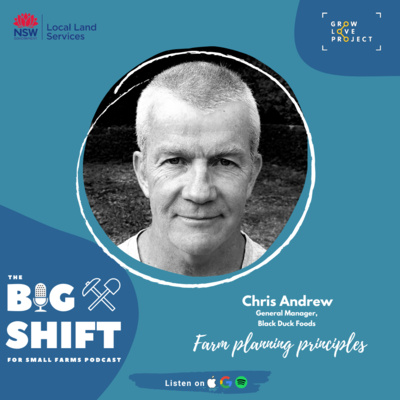
Farm Planning Principles
We often think of a plan as a list of things to do, but the farmers and consultants in this episode say it's about outlining your principles and developing a clear vision. In this episode the farmers encourage us to slow down, take a step back and learn from the landscape.
In this episode we hear from:
James Barnet - Grazing Management Consultant, RCS (rcsaustralia.com.au)
David Carr - Agroecologist, Stringybark Ecological (stringybarkecological.com.au)
Kirsty and Andrew Hambrook - Terrewah Farm (terrewahfarm.com.au)
Chris Andrew - General Manager, Black Duck Foods (blackduckfoods.org)
Josh Gilbert - Indigenous agriculturalist (gilbertjoshuam.com)
Produced by growloveproject.com on behalf of Greater Sydney Local Land Services
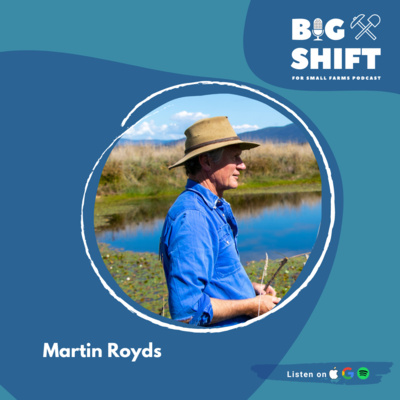
Regenerative farmers on holistic thinking
Why do you farm the way you do? In this episode we’ll hear from farmers who, through personal illness and tragedy have been forced to reimagine their farming values and practices. And we’ll hear who’s leading the way in holistic land management all to help you make the big shift.
In this episode we hear from
Brian Wehlburg, farmer/educator - https://www.insideoutsidemgt.com.au/
Virginia Mall, farmer - https://www.gracespringsfarm.net/
Martin Royds - https://www.jillamatong.com.au/martin-royds.html
Colin Seis, farmer - https://www.facebook.com/ColinSeis/
Murray Prior, farmer - https://www.nguurruu.com/
Other links to things covered in this episode
Local Land Services field day events - https://www.lls.nsw.gov.au/news-and-events/events
Field of Farmers by Joel Salatin, Polyface Farm - http://www.polyfacefarms.com/product/fields-of-farmers/
Alan Savory Ted Talk - http://tiny.cc/savorytedtalk
Credits
This podcast has been produced by the Grow Love Project with support from Greater Sydney Local Land Services, through funding from the Australian Government's National Landcare Program.
We acknowledge the traditional custodians of this land throughout Australia and recognise their continuing connection to land, waters and community. We pay our respects to elders past, present and emerging.
Farm certification the pros and cons
There’s a growing trend amongst consumers to know how their food is produced. Certification offers some assurity to customers and a point of difference for producers. But is it certification effective? We’ll chat with farmers who are certified and let you in on a secret that can be even more powerful than a certified label.
In this episode we hear from
Christina Kelman, farmer - https://ritas-farm-produce.myshopify.com/
Tobias Bland, farmer - https://www.instagram.com/kurrawongorganics
Professor Rachel Ankeny - https://twitter.com/ankeny_rachel
Brian Wehlburg, farmer - https://landtomarket.com.au/
Phil Taylor, manager - https://thebeachesmarket.com/
Greg newell, farmer - https://www.buymeat.com.au/
Shannon Kelly, Full Circle Farm - https://fullcirclefarm.com.au/
Other links to things covered in this episode
https://www.aph.gov.au/Parliamentary_Business/Committees/Senate/Economics/Food_Cert_Schemes/~/media/Committees/economics_ctte/Food_Cert_Schemes/c02.pdf
Food Values Group - https://arts.adelaide.edu.au/humanities/food-values/
Credits
This podcast has been produced by the Grow Love Project with support from Greater Sydney Local Land Services, through funding from the Australian Government's National Landcare Program.
We acknowledge the traditional custodians of this land throughout Australia and recognise their continuing connection to land, waters and community. We pay our respects to elders past, present and emerging.
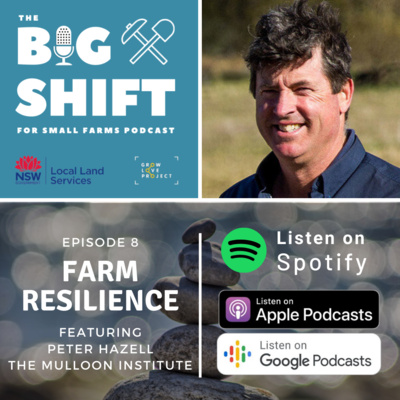
Farm resilience in a changing climate
Farm resilience in a changing climate is all about understanding the function of our natural landscapes. With longer and hotter droughts and more intensified rain events we need to rethink our current farming practices. So today, we’re going on a journey from the classroom to the paddock to help make your farm a resilient one.
Thank you to those who gave their time to be part of this episode:
David Marsh, farmer - http://www.arlash.com/tag/david-marsh/
Walter Jehne, soil microbiologist - https://www.healthysoils.com.au/
Christina Kelman, farmer - https://ritas-farm-produce.myshopify.com/
Peter Hazell - The Mulloon Institute - https://themullooninstitute.org/our-team
Martin Royds - https://www.jillamatong.com.au/martin-royds.html
Matthew - Jillamatong farm manager
Credits
This podcast has been produced by the Grow Love Project with support from Greater Sydney Local Land Services, through funding from the Australian Government's National Landcare Program.
We acknowledge the traditional custodians of this land throughout Australia and recognise their continuing connection to land, waters and community. We pay our respects to elders past, present and emerging.
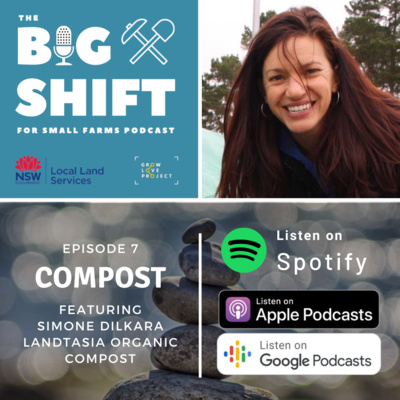
Compost gold
For farmers, compost is like black gold because its really valuable for efficient high quality food production, but just like gold it can be pretty expensive and hard to source. In this episode, we’ll talk to those who produce it, those who study it and those who use it to help you get the best out of your compost.
In this episode we hear from
Lizzie Buscaino - https://www.piccolofarm.com.au/
Eric Love, Centre For Organic Research and Education - https://core.asn.au/
Simone Dilkara - www.landtasiacompost.com
Olivier Sofo - https://livingearthfarm.com.au/
Manu Prigioni, Farm It Forward - https://www.farmitforward.com.au/
Martin Royds - https://www.jillamatong.com.au/martin-royds.html
Other links to things covered in this episode
Credits
This podcast has been produced by the Grow Love Project with support from Greater Sydney Local Land Services, through funding from the Australian Government's National Landcare Program.
We acknowledge the traditional custodians of this land throughout Australia and recognise their continuing connection to land, waters and community. We pay our respects to elders past, present and emerging.
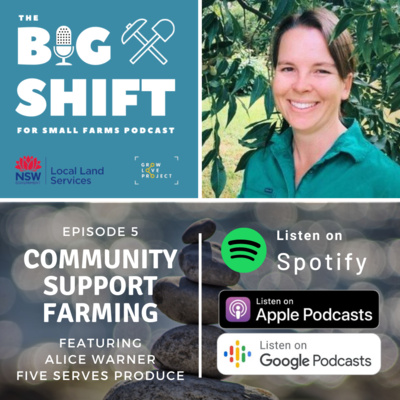
The benefits of Community Supported Agriculture
Community supported agriculture originates back to the 1960s and is a relatively new concept in Australia. At a time when more and more consumers are looking to connect to the source of their food, the CSA model could just be the best way for small scale farmers to grow their businesses.
In this episode we hear from
Alice Warner - https://fiveservesproduce.com.au/
Shannon Kelly - https://fullcirclefarm.com.au/
Lizzie Buscaino - https://www.piccolofarm.com.au/
Joel Orchard, CSA Network Australia and New Zealand - http://www.csanetworkausnz.org/
Credits
This podcast has been produced by the Grow Love Project with support from Greater Sydney Local Land Services, through funding from the Australian Government's National Landcare Program.
We acknowledge the traditional custodians of this land throughout Australia and recognise their continuing connection to land, waters and community. We pay our respects to elders past, present and emerging.
Supply chain innovations - mobile abattoirs
When it comes to getting your livestock processed. getting to an abattoir can be time-consuming for you and stressful for the animals. in light of this, some innovative farmers are disrupting the conventional supply chain and building their own solutions. From cardboard prototypes to shipping containers we’ll hear their stories and how they got the cash to get started to work out if a mobile abattoir is the right solution for you.
In this episode we hear from
Anita Taylor & Sarah Burrows - www.red8produce.com.au
Michael Hicks - www.extraordinarypork.com.au
Chris Celovic, Manager International Engagement, DPI - https://au.linkedin.com/in/chris-celovic-3b2b4953
Other links to things covered in this episode
https://www.business.gov.au/Grants-and-Programs/Minimum-Viable-Product-NSW
Credits
This podcast has been produced by the Grow Love Project with support from Greater Sydney Local Land Services, through funding from the Australian Government's National Landcare Program.
We acknowledge the traditional custodians of this land throughout Australia and recognise their continuing connection to land, waters and community. We pay our respects to elders past, present and emerging.

Cultivating wellbeing on farm
According to Mental Health Australia, 1 in 5 Australians are affected by mental illness, yet many don’t seek help because of stigma. And that’s what this episode is all about. We’ll hear from a farmer who’s grappled with the dark side of mental health and we’ll talk to experts and professionals about how to keep it in check. Because mental health and well-being is not just a state of mind it’s a skill. Something we can all practice.
In this episode we hear from
Dr. Rachel Clements, Centre for Corporate Health - https://cfch.com.au/
Michael Gooden, farmer - https://www.oldmancreek.com.au/
Katherine Newton, CEO RUOK - https://www.ruok.org.au/
Pip Job, DPI Business and Social Resilience Program coordinator - http://tiny.cc/PipJob
Other links to things covered in this episode
Rural resilience program - https://www.dpi.nsw.gov.au/about-us/rural-support/rural-resilience-program
Michael Gooden’s story online - https://mphn.org.au/story/michael
Credits
This podcast has been produced by the Grow Love Project with support from Greater Sydney Local Land Services, through funding from the Australian Government's National Landcare Program.
We acknowledge the traditional custodians of this land throughout Australia and recognise their continuing connection to land, waters and community. We pay our respects to elders past, present and emerging.
Building healthy soils
When it comes to agricultural productivity it all begins with the soil. In this episode we’ll hear from experts in the field and scientists in the lab about the power of health soils. And we’ll get our hands dirty with veggie growers and cattle farmers about how to achieve it.
In this episode we hear from
Manu Prigioni, Farm It Forward - https://www.farmitforward.com.au/
David Hardwick, agroecologist - https://www.soillandfood.com.au/
Olivier Sofo, Living Earth Farm - https://livingearthfarm.com.au/
Lizzie Buscaino, Piccollo Farm - https://www.piccolofarm.com.au/
Brian Wehlburg, farmer/educator - https://www.insideoutsidemgt.com.au/
Shannon Kelly, Full Circle Farm - https://fullcirclefarm.com.au/
Justine Cox, soil scientist - https://au.linkedin.com/in/justine-cox-a262453a
Other links to things covered in this episode
Northern Rivers Soil Health Card - http://tiny.cc/soilhealthcard
Local Land Services field day events - https://www.lls.nsw.gov.au/news-and-events/events
Credits
This podcast has been produced by the Grow Love Project with support from Greater Sydney Local Land Services, through funding from the Australian Government's National Landcare Program.
We acknowledge the traditional custodians of this land throughout Australia and recognise their continuing connection to land, waters and community. We pay our respects to elders past, present and emerging.
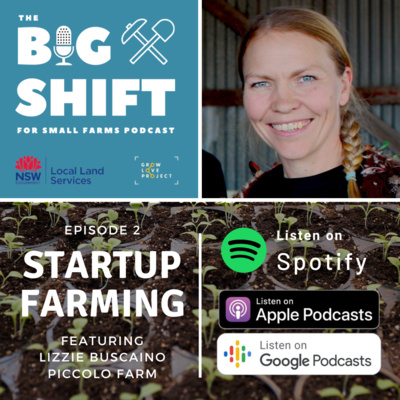
How to become a startup farmer
We often hear in the media that young people are leaving the farm in favour of other career paths. But what we don’t hear about are those in the city who feel the need to get their hands dirty and create a business growing food. In this episode we’ll hear about the challenges they’ve faced and the rewards they’ve gained.
In this episode we hear from
Lizzie Buscaino, Piccollo Farm - https://www.piccolofarm.com.au/
Shannon Kelly, Full Circle Farm - https://fullcirclefarm.com.au/
Joel Orchard, Young farmers Connect - https://www.youngfarmersconnect.com/
Olivier Sofo, Living Earth Farm - https://livingearthfarm.com.au/
Sam Marwood, Cultivate Farms - hhttps://www.cultivatefarms.com/
Manu Prigioni, Farm It Forward - https://www.farmitforward.com.au/
Other links to things covered in this episode
Australian Market Gardening Group - https://www.facebook.com/groups/AMGSG/
Field of Farmers by Joel Salatin, Polyface Farm - http://www.polyfacefarms.com/product/fields-of-farmers/
Farmer Incubator - https://farmerincubator.org/
ABS statistics - Farmer average age
https://www.abs.gov.au/AUSSTATS/abs@.nsf/Lookup/7121.0Main+Features12017-18?OpenDocument
Credits
This podcast has been produced by the Grow Love Project with support from Greater Sydney Local Land Services, through funding from the Australian Government's National Landcare Program.
We acknowledge the traditional custodians of this land throughout Australia and recognise their continuing connection to land, waters and community. We pay our respects to elders past, present and emerging.
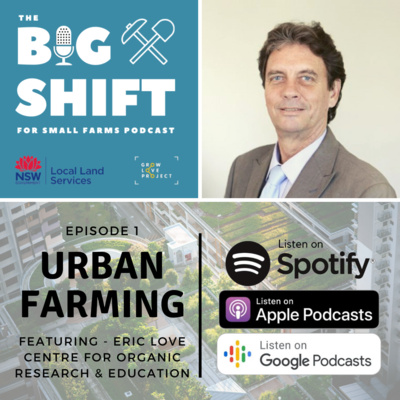
Urban farming may become essential
Farming in urban areas and on the outskirts of our major towns and cities, holds much promise for delivering healthy and safe food to our cities. Urban farms not only provide local employment, but serve as educational hubs for those wanting to learn about food production and become more self-sufficient.
In this episode we hear from
Julian Cribb, journalist and science communicator - https://juliancribb.blog/
Belinda Thackeray, Sydney Urban Farm - https://www.cityofsydney.nsw.gov.au/community/participation/sydney-city-farm
Cal Champagne, Green Connect - https://green-connect.com.au/
Meng Sun, Sun’s Fresh Farm - https://www.facebook.com/SunsFreshFarm/
Manu Prigioni, Farm It Forward - https://www.farmitforward.com.au/
Lizzie Buscaino, Piccollo Farm - https://www.piccolofarm.com.au/
Eric Love, Centre For Organic Research and Education - https://core.asn.au/
Clarence Slockee, Director at Jiwah Pty Ltd https://www.jiwah.com.au/
Other links to things covered in this episode
https://www.westernsydneyparklands.com.au/places-to-go/urban-farms-2/
Credits
This podcast has been produced by the Grow Love Project with support from Greater Sydney Local Land Services, through funding from the Australian Government's National Landcare Program.
We acknowledge the traditional custodians of this land throughout Australia and recognise their continuing connection to land, waters and community. We pay our respects to elders past, present and emerging.

The Big Shift for Small Farms - Trailer
We're very excited to bring you a podcast series dedicated to helping small scale farmers. We'll cover topics ranging from soil health to mental health and everything in between.
Tune in each fortnight as we bring you conversations with farmers and industry experts to help you make the big shift.
This podcast has been produced by the Grow Love Project with support from Greater Sydney Local Land Services, through funding from the Australian Government's National Landcare Program.
We acknowledge the traditional custodians of this land throughout Australia and recognise their continuing connection to land, waters and community. We pay our respects to elders past, present and emerging.