
Weekly Sermons - UumcTulsa Church
By University UMC - Tulsa
When Conflict Comes: A Spiritual Framework for Reconciliation
Conflict is part of being human—and part of being the church. In Matthew 18:15–20, Jesus gives us a practical way to address conflict within the Christian community, not by avoiding it or forcing reconciliation, but by approaching one another with love, truth, and care.
In this message, we explore Paul’s letter to Philemon as a powerful example of reconciliation. Paul appeals rather than commands, refuses to force the outcome, and is willing to bear the cost himself. From this story comes a framework for reconciliation: approach one another in love, make reconciliation voluntary, and be willing to sacrifice our pride.
But reconciliation doesn't always mean restoring every relationship. Sometimes forgiveness means letting go rather than becoming friends again. The invitation is to prayerfully discern which conflicts need to be addressed—and then to find the courage and support to take that step.
Scripture: Matthew 18:15–20; Philemon
The Next Faithful Step — Lauren Miers’ First Sermon
What is God calling you to do next?
In her first sermon at University United Methodist Church, Administrative Council Chair Lauren Miers reflects on the call of Jeremiah and the ways God invites ordinary people into lives of purpose and service.
Jeremiah's story reminds us that we don't always feel ready when God calls. Yet God knows us, God is with us, and God equips us with gifts that can be used in service. Lauren invites us to pay attention to those gifts, to recognize and name the gifts we see in one another, and to discern God's call together as a community.
Sometimes the next faithful step is small. Sometimes it changes everything. Either way, we don't take it alone.
“The edge of what feels possible is the end of ourselves and the beginning of our faith.”
In this first sermon, Lauren shares how her own journey—including her path to leadership at UUMC—has unfolded through a series of faithful steps, and she invites the congregation to listen for God's renewed call in their own lives.
Scripture: Jeremiah 1:4–10
Preacher: Lauren Miers, Administrative Council Chair
University United Methodist Church, Tulsa, Oklahoma
Stop Hiding. Come Back to God.
If you’ve been hiding—from God, from people, or even from yourself—this message is for you.
This sermon talks about shame, grace, and why Jesus is still calling you back. Not to condemn you, but to restore you.
You don’t have to fix yourself first. Just come.
Hearing God in the Noise
Life is loud—and it’s getting harder to recognize what’s actually true.
Jesus says His sheep know His voice. But how do we hear Him when everything else is competing for our attention?
This message explores how to truly know Christ, recognize His voice, and follow Him in a distracted world. Through Scripture, service, and prayer, we learn how to tune out the noise and listen for the voice that calls us to peace, love, and transformation.
If you’ve ever wondered whether you’re really hearing God—or just your own thoughts—this conversation is for you.
I Almost Missed Jesus
In this message, we reflect on how easy it is to miss the presence of Christ in our everyday lives. Through Scripture and a personal story, this sermon invites us to pay attention, open our hearts, and recognize the ways God is already moving around us. What if the moments we overlook are the very places Christ is meeting us?
Doubt Isn’t the Enemy: Faith in the Midst of Questions
Doubt is often seen as weakness—but what if it’s actually part of a healthy faith?
In this sermon, we reflect on the story of Thomas and the reality that doubt is not something to fear or suppress. Instead, it can lead us into deeper trust, deeper questions, and ultimately a more resilient faith.
Whether you’re in a season of certainty or uncertainty, this message offers a grounded and honest look at what it means to believe.
What If It's True? | The Empty Tomb & Why It Changes Everything
What if Easter isn’t just a tradition… but the most important event in history?
In this Easter message, we wrestle with the biggest question of Christianity:
Is it true?
What if Jesus really rose from the dead?
What if the empty tomb changes everything?
What if faith requires more than comfort — but leads to real transformation?
This sermon explores doubt, fear, change, and the invitation of Easter — especially for those who are skeptical, searching, or wondering if faith still matters today.
If you're tired of politics, anxiety, and a world that feels broken… this message is for you.
Because if the resurrection is true…
Everything changes.
Hosanna & the Fickle Crowd | Palm Sunday, Power, and the Politics of Jesus
Palm Sunday begins the greatest story ever told — but the crowd that shouts Hosanna on Sunday will shout Crucify Him by Friday.
Why?
In this Palm Sunday sermon, we explore Jesus’ humble entrance into Jerusalem, the meaning of true power, and why Jesus refuses to be claimed by political movements — ancient or modern.
Set in a high-liturgical worship environment with pipe organ, palms, and ancient tradition, this message invites us to follow Jesus beyond the crowd and into Holy Week.
This is Act One of the four-part story:
• Palm Sunday
• Maundy Thursday
• Good Friday
• Easter Sunday
Join the journey.
When God Feels Late: Standing at the Tomb with Lazarus
“Lord, if you had been here…”
In this message from John 11, we step into the grief of Martha and Mary—and into a question many of us have asked: Where was God when I needed Him?
This sermon explores the tension between faith and unanswered prayer, the reality of death, and the deeper hope revealed in Jesus Christ.
As Lent draws us closer to Easter, we are reminded:
Christ does not avoid death—He enters it.
And in doing so, He breaks its power.
This is a message for anyone navigating loss, doubt, or waiting on God.
You are called out of the grave.
Now come… and be unbound.
Psalm 23: God’s Grace in Every Season
Psalm 23 offers one of the most powerful reminders in Scripture: God is present in every season of life.
In this message we reflect on the familiar words, “The Lord is my shepherd,” and explore what they mean for us today. From the green pastures to the valley of the shadow of death, Psalm 23 reminds us that God’s grace and provision remain constant—even when we cannot see it.
This sermon explores:
• Trusting God when life feels uncertain
• Walking through dark seasons without fear
• God’s abundance even when our cup feels empty
• The upside-down nature of the Kingdom of God
• Why faith is meant to be lived in community
The Christian journey is not meant to be walked alone. Together we remind one another that God’s goodness and mercy follow us all the days of our lives.
Scripture: Psalm 23
A Companion for the Journey | Hope Through Suffering (Romans 5)
Why does suffering exist, and where is God when life becomes difficult?
In this sermon from Romans 5, we explore one of the most powerful teachings of the Apostle Paul: suffering is not meaningless. Instead, it forms a spiritual chain that leads to hope.
Paul writes that suffering produces perseverance, perseverance produces character, and character produces hope. But this hope is not simply optimism—it is grounded in the life, death, and resurrection of Jesus Christ.
Through faith, Christ becomes more than a distant figure in history. He becomes a companion on the journey, walking with us through suffering, growth, repentance, and transformation.
In this message we reflect on:
• Why humans long for companionship in life and faith
• How Christ walks with us even in suffering
• The purpose of the Lenten journey of self-examination
• What it means that Christ died for us while we were still sinners
• Why Christians boast not in themselves, but in the hope God provides
The Christian life is not something we figure out in a single moment. It is a lifelong journey of learning what the cross and resurrection mean for us—and discovering that we never walk that road alone.
Scripture: Romans 5
The Promise of New Life | Jesus, Nicodemus, and Being Born Again (John 3)
What did Jesus really mean when he said we must be born again?
In John 3, a Pharisee named Nicodemus comes to Jesus with honest questions. Their conversation leads to one of the most famous verses in Scripture — John 3:16 — and a powerful promise about the new life God offers through the Spirit.
In this message we reflect on:
• Why promises matter so deeply in our lives
• Why broken promises hurt so much
• What Jesus meant by being born of water and the Spirit
• How baptism points to new life in Christ
• And how God’s promises guide us when life feels uncertain
This sermon invites us to consider whether we are willing to let God transform how we see the world — and ourselves.
Scripture: John 3:1-17
Jesus in the Wilderness: Facing Hunger, Fear, and Temptation | Matthew 4:1–11
Have you ever felt like you were wandering through a wilderness in life?
In this sermon from Gospel of Matthew 4:1–11, we explore the story of Jesus being led into the wilderness and facing temptation. The wilderness can be a frightening place—full of uncertainty, loneliness, and questions. Yet Scripture shows that it is often in the wilderness where transformation begins.
Jesus confronts three deep human struggles: hunger, fear, and the temptation to misuse power. These are not just ancient temptations—they are the same pressures people face today. When we feel spiritually empty, when fear drives our decisions, or when we’re tempted to take control rather than trust God, this passage speaks directly to us.
The good news is that Christ has walked this road before us. He understands the wilderness, and He walks with us through it.
This message reflects on:
Why wilderness seasons happen in our lives
The deeper meaning behind Jesus’ temptations
How Scripture equips us to resist temptation
Why we never face the wilderness alone
Whether you’re in a season of doubt, struggle, or growth, this passage reminds us that God is present even in the most desolate places.
#Bible #ChristianPodcast #Sermon #Faith #Matthew4 #Lent #SpiritualGrowth
A Glimpse of Glory | Transfiguration Sunday
On this Transfiguration Sunday, we dive into Matthew 17:1-9, where Jesus is revealed in radiant glory to Peter, James, and John. This sermon reflects on the foretaste of God’s glory and how these moments of divine revelation strengthen our faith and hope.
Discover how the transfiguration of Christ invites us to:
Recognize God’s presence in our daily lives
Grow in faith through glimpses of divine glory
Live with the hope of transformation in Christ
Perfect for personal devotion, reflection, or sharing with your congregation.
The Mind of Christ (1 Corinthians 2:1–12)
In this message from 1 Corinthians 2:1–12, we examine Paul’s teaching on what it means to have the mind of Christ. True spiritual understanding doesn’t come through human wisdom alone, but through revelation from the Holy Spirit.
This sermon explores how God reveals His truth, how believers grow in spiritual discernment, and how living with the mind of Christ shapes faith, maturity, and daily life.
What Kind of God Steps Into the Mess? (Baptism of the Lord)
On Baptism of the Lord Sunday, a college student reflects on Jesus’ baptism in the Jordan River and what it reveals about the heart of God. Before preaching or performing miracles, Jesus steps into the waters alongside sinners—choosing obedience, humility, and identification with humanity.
This sermon explores Matthew 3 and invites listeners to consider a God who does not avoid our mess, but enters it with us, offering grace, healing, and new life.
Epiphanies: The Wise Still Seek Him (Matthew 2:1–12)
In this sermon, Epiphanies, we reflect on Matthew 2:1–12 and the journey of the Magi — wise seekers who followed the light they were given until it led them to Christ.
This message explores how God reveals Himself through moments of Epiphany, how seeking requires humility and perseverance, and why faith is often marked by movement rather than arrival. The story of the Magi reminds us that the wise still seek Him.
Scripture: Matthew 2:1–12
God Is Coming for You | Advent Week 4 (Matthew 1:18–25)
In the midst of life’s messiness, God is present and waiting for you. Pastor Matt shares three practical steps to live faithfully, even when life feels overwhelming:
Keep your eyes on Jesus – the pioneer and perfecter of our faith.
Pray for spiritual vision – learn to see God’s presence all around you. Christ is always with us; sometimes we just fail to notice.
Do the next faithful thing – obey God in the small, next steps, trusting He will guide your path. As 1 Samuel 15:22 reminds us: “To obey is better than sacrifice, and to heed is better than the fat of rams.”
Even when the way forward is unclear, you can take the next faithful step and trust that God is leading you.
Waiting Patiently for the Promise | Advent Week 3 (Luke 1:46b–55)
What does it mean to wait with hope in a world that feels uncertain?
In this Advent sermon, Rev. Matt Patrick reflects on Mary’s song—the Magnificat—from Luke 1:46b–55. Through Mary’s words, we are reminded that God is faithful across generations, lifting the lowly, filling the hungry, and keeping promises even when the waiting feels long.
This message is especially for teens, young adults, and families longing for hope, joy, and transformation during the Advent season.
📖 Scripture: Luke 1:46b–55📍 University United Methodist Church | Tulsa, OK
In this sermon, you’ll be invited to:
See God’s promises at work, even while waiting
Trust God’s faithfulness in seasons of uncertainty
Celebrate a hope that transforms hearts and communities
Preparing Our Hearts for Jesus | Advent Week 2 (Matthew 3:1–12)
In this Advent sermon, Rev. Matt Patrick explores John the Baptist’s call to prepare the way for Jesus. We examine repentance as transformation, baptism as a sign of new life, and how God’s promises invite hope, joy, and peace.
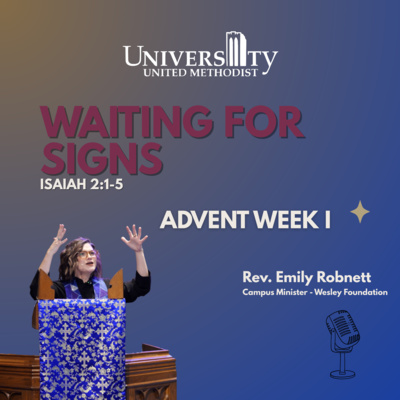
Finding God's Peace When the World Feels Dark | Advent Week 1 (Isaiah. 2:1–5)
In this Advent sermon, Rev. Emily Robnett explores how God meets us in the darkness and invites us to rest in His presence when life feels overwhelming.Many people enter Advent carrying stress, anxiety, or a sense of darkness — even though the season is often called “the most wonderful time of the year.” Drawing from Isaiah’s vision of turning swords into plowshares and the story of the Sawi people and the Peace Child, this message shows Jesus as God’s ultimate gift of peace and reconciliation.