The ConnectFirst™ Positive Behaviour Support Framework for Practitioners
By Meg Hughes
Episode 21: Writing the Comprehensive Behaviour Support Plan
Episode 21: Writing the Comprehensive Behaviour Support Plan
Welcome to Episode 21 of the ConnectFirst Positive Behaviour Support Podcast: Writing the Comprehensive Behaviour Support Plan.
In this episode, we bring the assessment process together and explore how to write a Comprehensive Behaviour Support Plan that is clear, practical and genuinely useful for the people supporting the participant every day.
We discuss how to translate functional assessment information into a meaningful formulation, person-centred goals and proactive strategies. We also consider the importance of writing in plain language, including the participant’s voice, clearly describing what support looks like in practice, and ensuring the plan can be implemented consistently across home, school, community and service settings.
A strong plan is more than a compliance document. It is a shared guide that helps people understand the person, respond with compassion and consistency, and create the conditions in which they can feel safe, regulated, included and able to thrive.
To continue building your Positive Behaviour Support knowledge, explore the ConnectFirst Annual Membership and online learning platform at www.connectfirst.com.au, or learn more about our Become a Behaviour Support Practitioner Course and Practitioner Pathway at https://careers.connectfirst.com.au/.
Episode 20 - Identifying RRP
Welcome to Episode 20 of the ConnectFirst podcast.
Today we are discussing how to identify regulated restrictive practices, often referred to as RRPs.
This is an essential area of practice for any Behaviour Support Practitioner. Restrictive practices can be unintended, embedded in everyday routines, or described as support strategies. Our role is to look beyond the label and consider the effect the practice has on the person’s rights, choice, movement, access, relationships and dignity.
Under the NDIS Quality and Safeguards Commission framework, a restrictive practice is an intervention that has the effect of restricting the rights or freedom of movement of a person with disability. The five regulated restrictive practices are seclusion, chemical restraint, mechanical restraint, physical restraint and environmental restraint.
It is important to remember that a practice does not need to be called a restraint to be restrictive. For example, locking a pantry, restricting access to food or personal belongings, blocking an exit, using medication primarily to control behaviour, holding a person to stop them moving, or preventing access to community activities may all require careful consideration.
When identifying a possible restrictive practice, start with respectful curiosity. Ask: What is happening? What is the purpose of this strategy? What is the person prevented from doing, accessing or choosing? Is there a genuine risk that needs to be addressed? Have less restrictive, proactive and person-centred alternatives been tried?
Behaviours of concern are forms of communication. Before considering any response, we need to understand what the behaviour may be communicating and the factors that may be contributing. This includes the person’s environment, sensory needs, communication, health, trauma history, relationships, expectations, access to meaningful activities and personal autonomy.
A restrictive practice must never be used for convenience, punishment, discipline, coercion, retaliation, or because other supports have not been put in place. If a restrictive practice is identified, it must be reported and managed in line with NDIS requirements and the relevant state or territory authorisation and reporting arrangements.
The Behaviour Support Practitioner’s role is not simply to record that a restrictive practice exists. We must work collaboratively with the person, their family, support team and relevant professionals to understand the reason it is being used, assess the risks, develop an interim or comprehensive behaviour support plan where appropriate, and actively work towards reduction and elimination.
The key principle is always least restrictive practice. This means using the minimum restriction necessary for the shortest possible time, only when there is a demonstrated risk of harm, and alongside proactive strategies that build safety, skills, communication, choice and quality of life.
Identifying restrictive practices is safeguarding work. It protects people’s human rights and keeps the focus where it belongs: supporting each person to live a safe, meaningful and self-directed life.
Thank you for listening to Episode 15 of the ConnectFirst podcast. In the next episode, we will explore how to respond once a potential restrictive practice has been identified and how to develop safer, individualised alternatives.
Episode 18: Measurable Outcomes in Positive Behaviour Support
Episode 18: Measurable Outcomes in Positive Behaviour Support
Welcome to Episode 18 of the ConnectFirst Positive Behaviour Support Podcast: Measurable Outcomes in Positive Behaviour Support.
In this episode, we explore how to develop meaningful outcomes that show whether behaviour support is making a genuine difference in a person’s life. Strong outcomes are not simply about reducing behaviour of concern. They should reflect what the person wants, needs and values, including greater choice, communication, safety, relationships, participation and quality of life.
We discuss how to write outcomes that are individualised, observable and measurable, and how to use baseline information and regular review to track progress over time. You will also hear why it is important to measure the success of proactive strategies, skill development and environmental changes, not only the frequency of behaviour.
This episode will help you create outcomes that keep the Comprehensive Behaviour Support Plan focused on what truly matters: supporting a good life.
To continue building your Positive Behaviour Support knowledge, explore the ConnectFirst Annual Membership and online learning platform at www.connectfirst.com.au, or learn more about our Become a Behaviour Support Practitioner Course and Practitioner Pathway at https://careers.connectfirst.com.au/.
Episode 17 - Collecting Data for the CBSP
Welcome to Episode 17 of the ConnectFirst Positive Behaviour Support Podcast: Collecting Data for the Comprehensive Behaviour Support Plan.
In this episode, we explore how meaningful data helps us move beyond assumptions and develop a clear, person-centred understanding of behaviour. We will discuss the types of information that matter most, including observations, incident reports, ABC data, stakeholder perspectives and quality-of-life information.
We also consider how to collect data ethically, collaboratively and in ways that are practical for the people supporting the participant every day. The goal is not to collect data for the sake of it; it is to use it to identify patterns, understand unmet needs, and guide strategies that improve safety, regulation, participation and quality of life.
Whether you are developing a Comprehensive Behaviour Support Plan or strengthening your everyday practice, this episode will help you make your assessment process more purposeful, organised and meaningful.
Episode 16 - Implementation Plan
Welcome to Episode 16 of the ConnectFirst podcast.
In this episode, we are discussing implementation plans: the practical bridge between a behaviour support plan and the support that a person experiences every day.
A well-written behaviour support plan is important, but it only creates change when the strategies within it are understood, practised, implemented consistently and reviewed. An implementation plan helps make this happen.
An implementation plan clearly sets out what will be done, who is responsible, when it will happen, and how the team will know it is working. It takes broad recommendations and turns them into realistic, everyday actions.
For example, a behaviour support plan may recommend increasing choice, reducing demands during periods of distress, supporting communication, or making changes to the environment. The implementation plan explains exactly how these strategies will look in practice for that individual person.
It may include the specific routines where a strategy will be used; who needs training or coaching; the resources required; how the person’s preferences and voice will be included; and what information the team will collect to monitor progress.
The most effective implementation plans are developed collaboratively. The person, their family, support workers, educators, allied health professionals and other important people should be involved wherever possible. Each person brings valuable insight into what is realistic, what has worked before, and what may create barriers to success.
It is also important to be clear about responsibilities. When everyone assumes someone else will implement a strategy, it is very easy for nothing to change. Clear actions, agreed timeframes and regular check-ins support accountability while also recognising that implementation is a shared responsibility.
Implementation must remain flexible and responsive. If a strategy is not working, we need to be curious. Is the strategy truly meeting the person’s needs? Has the team received enough training? Is the environment supporting the strategy? Is the approach being applied consistently? Or has something changed for the person?
Data and feedback are essential. This does not always need to be complicated. It may include simple observations, the person’s feedback, patterns in incidents, use of proactive supports, or changes in participation, wellbeing and quality of life.
The aim is never compliance for the sake of compliance. The aim is to create safer, more respectful and more meaningful support that improves the person’s daily life.
A strong implementation plan keeps the focus on proactive, individualised and least restrictive practice. It helps teams move away from reacting to behaviour and towards understanding communication, preventing distress and building the person’s skills, autonomy and opportunities.
Thank you for listening to Episode 16 of the ConnectFirst podcast. Remember, a plan is only as effective as the support that brings it to life.
Episode 15 - Implementing Effective Strategies
In this episode, we explore what effective behaviour support strategies actually look like in practice.
Once we understand what a behaviour may be communicating, the focus shifts to developing individualised, proactive and least restrictive supports. We discuss how to move beyond generic strategies, consider the person’s communication, sensory, emotional and environmental needs, and support teams to implement strategies consistently and respectfully.
This episode is for Behaviour Support Practitioners, support workers, educators and families who want to create meaningful change while protecting each person’s dignity, rights and autonomy.
Episode 14: Good Record Keeping and Progress Notes
Episode 14: Good Record Keeping and Progress Notes
Good record keeping is an essential part of safe, ethical and effective behaviour support practice. In this episode, we explore how to write clear, respectful and useful progress notes that support continuity of care, communication within teams and meaningful review of supports over time.
We discuss objective language, protecting privacy, recording relevant information and ensuring documentation reflects the person’s goals, experiences and voice.
At ConnectFirst, we support Behaviour Support Practitioners through supervision, professional development, practical resources and specialised online courses. Our annual membership includes access to over 50 behaviour support courses, a monthly Community of Practice and ongoing learning opportunities.
To find out more, visit ConnectFirst.
Episode 13: Developing a Behavioural Formulation
Episode 13: Developing a Behavioural Formulation
A behavioural formulation helps practitioners move beyond responding to behaviour in the moment and develop a deeper understanding of what may be happening for a person. In this episode, we explore how to bring together information about strengths, communication, health, relationships, sensory experiences, environmental demands and life circumstances.
We discuss how a thoughtful, collaborative and person-centred formulation can guide meaningful Positive Behaviour Support strategies.
If you are building your confidence as a Behaviour Support Practitioner, ConnectFirst offers specialised training, supervision, practical resources and over 50 online behaviour support courses. Our annual membership also includes a monthly Community of Practice, connecting practitioners who are committed to safe, ethical and neuroaffirming practice.
To learn more, visit ConnectFirst.
Episode 12 - Check-ins with Parents and Support Workers
Episode 12: Check-ins with Parents and Support Workers
Regular check-ins with parents, carers and support workers are essential to effective, person-centred behaviour support. In this episode, we explore how purposeful communication helps practitioners understand what is happening across environments, monitor strategies, identify emerging concerns and ensure that plans remain practical in everyday life.
We discuss useful questions to ask, how to keep check-ins strengths-based and collaborative, and the importance of documenting key information while respecting privacy and professional boundaries. This episode is particularly helpful for new Behaviour Support Practitioners building confidence in communicating with families and support teams.
For further practical support, ConnectFirst™ offers specialised behaviour support training, individual supervision, and over 50 self-paced courses for Behaviour Support Practitioners. Our annual membership also includes access to selected courses, resources and a monthly Community of Practice. Visit ConnectFirst™ to explore the support available.
Episode 11 - Writing the Interim Plan
Episode 11 - Writing the Interim Plan, a practical episode for Behaviour Support Practitioners navigating one of the most important early documents in behaviour support.
An interim behaviour support plan is not a full functional assessment or final plan. It is a short-term, person-centred plan designed to help keep the person and others safe while you gather information, build relationships and complete a comprehensive assessment. In this episode, we will explore what to include, how to keep the plan practical and strengths-based, and how to ensure any restrictive practice is clearly identified, reported and reduced.
If you would like further support with your behaviour support practice, ConnectFirst™ offers individual supervision, specialised professional development, and over 50 self-paced behaviour support courses. You can also join our annual membership for access to courses, resources and our monthly Community of Practice. Visit ConnectFirst™ to explore the support available.
Episode 10 - ABCs and Data Collection
In Episode 10, we unpack ABC data collection and how a simple QR code can make it easier for families, educators and support teams to capture meaningful information in the moment. Learn what to record, how to identify patterns, and how quality data supports more responsive, person-centred behaviour support.
For more information and access to practical, evidence-informed training created specifically for Behaviour Support Practitioners, join the ConnectFirst™ Membership at www.connectfirst.com.au. Members receive access to specialised online courses, exclusive live training and events, a growing resource library, Community of Practice sessions and member-only offers to support them at every stage of their BSP journey.
Episode 9 - Case Meetings
In Episode 9, we explore how effective case meetings strengthen collaboration, clarify responsibilities and keep the participant at the centre of decision-making. Learn practical strategies for preparing, contributing confidently and ensuring meetings lead to meaningful action in positive behaviour support.
For more information and access to practical, evidence-informed training created specifically for Behaviour Support Practitioners, join the ConnectFirst™ Membership at www.connectfirst.com.au. Members receive access to specialised online courses, exclusive live training and events, a growing resource library, Community of Practice sessions and member-only offers to support them at every stage of their BSP journey.
Episode 8 - Observations in a School Setting
In Episode 8, Meg explores how to conduct meaningful and respectful observations within a school setting. She discusses the importance of gaining appropriate consent, protecting the student’s dignity and observing without disrupting the classroom or singling the student out.
The episode examines what practitioners should look for, including classroom demands, communication, sensory factors, transitions, relationships, strengths and early signs of distress. Meg also explains how to record observable information, work collaboratively with school staff and consider the fit between the student and their environment. Thoughtful observation can help us look beneath behaviour, identify patterns and develop practical supports that improve regulation, participation and learning.
Episode 7 - Home Observations
In Episode 7, we discuss the importance of completing respectful, safe and meaningful observations in the home. Home observations help practitioners understand the person’s routines, relationships, communication, environment and the factors that may influence behaviour. The episode also explores how to approach observations sensitively, ensuring the person and their family feel informed, comfortable and genuinely involved throughout the process.
For more information and access to practical, evidence-informed training created specifically for Behaviour Support Practitioners, join the ConnectFirst™ Membership at www.connectfirst.com.au. Members receive access to specialised online courses, exclusive live training and events, a growing resource library, Community of Practice sessions and member-only offers to support them at every stage of their BSP journey.
Episode 6 - Positive Behaviour Support Budget Plan
In Episode 6, we explore how to develop a realistic and purposeful Positive Behaviour Support budget plan. This includes considering the person’s goals, complexity of support needs, identified risks, assessments, collaboration, plan development, training and ongoing implementation support.
For more information and access to practical, evidence-informed training created specifically for Behaviour Support Practitioners, join the ConnectFirst™ Membership at www.connectfirst.com.au. Members receive access to specialised online courses, exclusive live training and events, a growing resource library, Community of Practice sessions and member-only offers to support them at every stage of their BSP journey.
Episode 5 - Evidence-Based Assessments
In Episode 5, we explore the role of evidence-based assessments in Positive Behaviour Support. This episode discusses how assessments help practitioners build a clear understanding of the person’s strengths, needs, behaviour, communication, environment and quality of life, so supports are informed, individualised and meaningful.
For more information and access to practical, evidence-informed training created specifically for Behaviour Support Practitioners, join the ConnectFirst™ Membership at www.connectfirst.com.au. Members receive access to specialised online courses, exclusive live training and events, a growing resource library, Community of Practice sessions and member-only offers to support them at every stage of their BSP journey.
Episode 4 - The Intake
The intake is one of the most important conversations you will have during the behaviour support process. It begins your formal information gathering, but it is also an opportunity to establish trust, clarify expectations and understand the participant as a whole person.
An intake should not feel like an interrogation. You may have a detailed intake form containing many questions, but the form should guide the conversation, not control it. If you focus on filling every box, you may miss the meaning, emotion and context within what people are telling you.
If you enjoy my podcasts, I invite you to become a ConnectFirst™ member at www.connectfirst.com.au. As a member, you can access a range of free and paid online training courses and be among the first to receive exclusive offers for upcoming professional-development events.
Episode 3 - Working with Families
Families are often the people who know the participant best. They may understand subtle changes in expression, movement, voice and behaviour that other people miss. They may know the participant’s history, preferences, fears, routines and communication in ways that cannot be captured in a report. They may also have spent years advocating for support while being questioned, blamed, dismissed or required to repeat the same story to multiple professionals.
When a family meets another new practitioner, they may not immediately trust you. Trust is not something you can expect because you have a qualification, a practitioner identification number or a professional title. It develops through what you do. It grows when you listen, follow through, communicate clearly, admit when you do not know something and demonstrate that you see their child as a whole person.
If you enjoy my podcasts, I invite you to become a ConnectFirst™ member at www.connectfirst.com.au. As a member, you can access a range of free and paid online training courses and be among the first to receive exclusive offers for upcoming professional-development events.
Episode 2 - Preparing for the Intake
Episode 2
In the previous episode, we explored the process of accepting a referral. We discussed the importance of working within your scope, recognising the limits of your competence, checking your capacity, identifying conflicts of interest and gathering enough preliminary information to make an ethical decision about accepting the participant.
Once the referral has been accepted, the next step is preparing for the intake. It can be tempting to send a calendar invitation and assume that everything else can be addressed during the appointment. However, a good intake begins well before you sit down with the participant or their family.
Preparation is not simply an administrative step. It contributes to informed consent, participant safety, practitioner safety and the quality of the information you gather. It also communicates something important to the participant and their family: you are organised, you respect their time and you have thought carefully about how to make the process accessible to them.
If you enjoy my podcasts, I invite you to become a ConnectFirst™ member at www.connectfirst.com.au. As a member, you can access a range of free and paid online training courses and be among the first to receive exclusive offers for upcoming professional-development events.
Episode 1 - Accepting a Referral
Episode 1
In this episode, we are talking about accepting a referral. This might sound like an administrative task. A referral arrives, someone has behaviour support funding, and you add them to your calendar. However, accepting a referral is much more than saying yes to a new participant. It is one of the first significant professional decisions you will make as a behaviour support practitioner.
When a referral arrives, you do not yet know the participant. You may have only a short description written by a support coordinator, family member or service provider. It may say that the participant is aggressive, absconds, refuses instructions or displays challenging behaviour. It may contain a sense of urgency, with people wanting the service to commence immediately. You may also feel pressure to accept the referral, particularly when you are building your caseload or establishing yourself as a new practitioner.
If you enjoy my podcasts, I invite you to become a ConnectFirst™ member at www.connectfirst.com.au. As a member, you can access a range of free and paid online training courses and be among the first to receive exclusive offers for upcoming professional-development events.
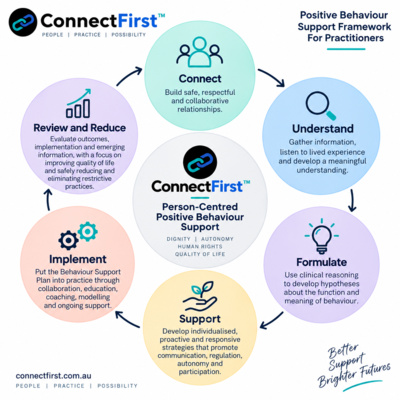
Welcome to the ConnectFirst™ Positive Behaviour Support Framework
Welcome to the ConnectFirst™ Positive Behaviour Support Framework
I created this podcast for Behaviour Support Practitioners who want practical, thoughtful and ethical guidance across the full behaviour support process.
You may be entering behaviour support through the alternative pathway, developing your capability as a practitioner, supervising others or looking for a clearer way to connect assessment, formulation, planning and implementation.
Wherever you are in your professional development, this series is designed to help you slow down, think critically and understand the person behind the behaviour.
Positive behaviour support is much more than completing an assessment or writing a behaviour support plan. It is a person-centred, evidence-informed and human-rights-based approach to improving quality of life.
If you enjoy my podcasts, I invite you to become a ConnectFirst™ member at www.connectfirst.com.au.
As a member, you can access a range of free and paid online training courses and be among the first to receive exclusive offers for upcoming professional-development events.